
2025 Annual Report - Looking Back At 2025

Introduction
In the midst of the fifth planting season Protect Earth is looking back at the 2024/25 season, to take a look at all our sites. With 60 sites across the UK, Protect Earth has been pushing forward its vision of a greener and more biodiverse and bioabundant country.
There are always successes and failures in a project of this scope and ambition. Protect Earth wants to be open and transparent about what we are - and what can be learned for the future, to ensure an even higher rate of success.
Protect Earth was started to create and restore woodlands, meadows and hedgerows in the UK. Born out of a desire to combat the escalating climate and biodiversity crisis, in the last four years, Protect Earth has planted new habitats all around the country. Three sites are directly managed by us; Nannerch, High Wood and Goytre Wood, which will be spotlighted to look at how they’re doing.
Why We Do What We Do
Tree planting can remove carbon from the atmosphere, reduce the risk of flooding, enhance air quality and engage with local communities, bringing people into nature. Protect Earth works with landowners, businesses, environmental organisations and the public to create habitats and increase biodiversity.
Many sites have been planted with the help of volunteers, engaging people with the work and nature, encouraging a sense of empowerment to make positive change.
Have we got a quote from some volunteers here about how much they enjoy it, and from a landowner praising PE?
The Data
The data we are looking at is the survival rates as they stand in 2025, this includes restocking in previous years. Since this is the first year of a structured report on this, it is difficult to look at the effects of previous restocking, however wherever the data is available, we will include this in the analysis.
The survival rate is based on what percentage of the trees planted are still visibly alive. Sometimes this number can be skewed by extreme weather, leading to a young tree dying back to the roots - looking like it hasn’t survived. They can also be hidden under bracken or bramble, making it difficult to determine numbers. Where this has been encountered, generally a lower survival rate is logged.
The target rate for survival is 80%. This is because 100% survival is highly unlikely, and some margin for failure is included in the planting plans. 100% would likely cause overcrowding and would need to be thinned, as it would cause the trees to not do well so close together. Overstocking also ensures that canopy cover is achieved.
Across those 60 sites, we are missing data for 19 in 2025. This means that while we might be able to see some trends, this is a preliminary analysis for 2025 only. This can be updated as the other data comes in, enabling a more accurate understanding of what has and hasn’t worked over the past year.
With the sites we do have data for, it is not always complete - reasons for success or failure can be inferred, but in some cases it is not clear why a site might be doing particularly well or particularly badly. There is an opportunity to standardise survey methodology going forward to ensure the best possible data is available for analysis.
The Statistics
Across the 41 sites that we have the 2025 data for, the topline numbers for survival rates are:
Mean: 63.8%
Median: 66.0%
25th Percentile: 53.0%
75th Percentile: 78.5%
Minimum: 15.0%
Maximum: 99.0%
We will explore these numbers more by looking at survival rates in the best and worst performing sites, as well as across the regions and planting seasons.
Best and Worst Performing Sites
Best Performing Sites
5. Manafon
Location: Near Welshpool, Mid Wales
Planting Season: 23/24
Restocked 24/25: No
Survival Rate: 92%
Site: In a valley, plenty of water and shelter from the wind
4. Stawley (Bullock Hill)
Location: Southeast of Exmoor, Southwest
Planting Season: 23/24
Restocked 24/25: No
Survival Rate: 94%
Site: In Devon - great for tree growth, as long as they’re not eaten by deer
3. Howard Court
Location: Great Ayton, Middlesborough, York and Humber
Planting Season: 21/22
Restocked 24/25: No
Survival Rate: 95%
Site: Near a river, so good for access to water, with some existing tree coverage along the river
2. Looedown Farm
Location: Liskeard, Southwest
Planting Season: 23/24
Restocked 24/25: No
Survival Rate: 97%
Site: The terrain looks fairly well protected and seems to be fairly well-connected with hedges to other woodland
1. Hitchin Swinburne Recreation Ground
Location: Hitchin, Southeast
Planting Season: 22/23
Restocked 24/25: No
Survival Rate: 99%
Site: As a recreation ground, it could be significantly less polluted / compacted than planting farmland for example
Best Performing Sites Conclusions
There is a wide variation in the types of sites that have done particularly well, but there are a few common themes that show up across some or all of the sites.
-
The landowner is engaged in the work, and puts a lot of care and effort into the land
-
A lack of damage by deer, squirrels, sheep or other animals. This could be linked to point one, and/or luck
-
Three of the sites are in Southwest England and Wales, areas that promote good vegetative growth with a mild, damp Atlantic climate
Three out of the five top sites were planted in 23/24, so there is still a chance that the survival rates could drop. However, if the sites continued to be cared for in the way they are at the moment, the high survival rates should continue. However, for Howard Court and Hitchin, as they had earlier planting season, they may have been restocked previous to the 24/25 season - that data is currently unavailable.
Worst Performing Sites
5. St Mary & St John Primary School
Location: Oxford, Southeast
Planting Season: 24/25
Restocked 24/25: No
Survival Rate: 35%
Site: Primary school grounds
4. Cwmarirog (Pentwyn)
Location: Border, Mid Wales
Planting Season: 23/24
Restocked 24/25: No
Survival Rate: 30%
Site: Welsh hills and fields
3. Newcastle Emlyn
Location: Near Cardigan, Southwest Wales
Planting Season: 22/23
Restocked 24/25: No
Survival Rate: 25%
Site: Green wooded area surrounded by fields and streams
2. Bethania (Brynwichell Farm)
Location: Near Aberystwyth, Southwest Wales
Planting Season: 23/24
Restocked 24/25: No
Survival Rate: 25%
Site: Farm surrounded by fields and some wooded areas. Very acidic upland soil with peaty surface and is right next to another site with 85% survival
1. Mauchline (West Mossgiel Farm)
Location: East Ayrshire near Glasgow, Perth and Kinross
Planting Season: 24/25
Restocked 24/25: No
Survival Rate: 15%
Site: Farm surrounded by big fields, some hedgerows. Exposed to significant winds
Worst Performing Sites Conclusions
There are some strong indicators across the sites that clearly show the issues faced.
-
Bracken and himalayan balsam choking out the saplings
-
Failure to keep livestock out
-
Sites that are exposed to a lot of wind really struggle to get the trees away
-
There is also a theme of adverse weather events that could impact success, particularly on the sites in Oxford and East Ayrshire
Another issue lying behind some of these problems is that the landowners are not as engaged or well-informed, or resourced enough to provide the necessary care under difficult conditions to ensure success of the planting.
Spotlight: Nannerch
Nannerch was planted in January 2025, with a mix of sessile oak, silver birch, aspen, lime, crab apple, rowan, alder, wild cherry, elm, hazel, hawthorn and holly. Normally we wouldn’t survey the same year as planting, however there had been a drought, so we took a look.
Initially estimated at only 60% survival, a more thorough survey has pushed this up to 73.4%. Nannerch was initially planted during the most recent planting season (24/25), and it really typifies the kind of variations, challenges and successes that you can find on one site. Some planting was carried out with enthusiastic and engaged volunteers, and this planting did very well. These volunteers even came back to help with maintenance, showing what is possible where people really care. The maintenance is as important as the planting itself, and having people invested in a site’s continued care can vastly improve success rates.
The other side to this is challenges faced with the local contractors which did some of the planting too. It was the first time that Protect Earth has tried contracting the planting out, and unfortunately a lot of issues arose, including behaviour leading to complaints from neighbours, and planting below the standards that Protect Earth requires for planting. This is reflected in the much lower survival rates seen in the eastern field.
Both of these were exacerbated by the topography of the site - the north west fields which were planted by volunteers are also protected, from trees on two sides and a hill on another. The eastern field is far more exposed, meaning that wind and sun could contribute to the lower survival rates.
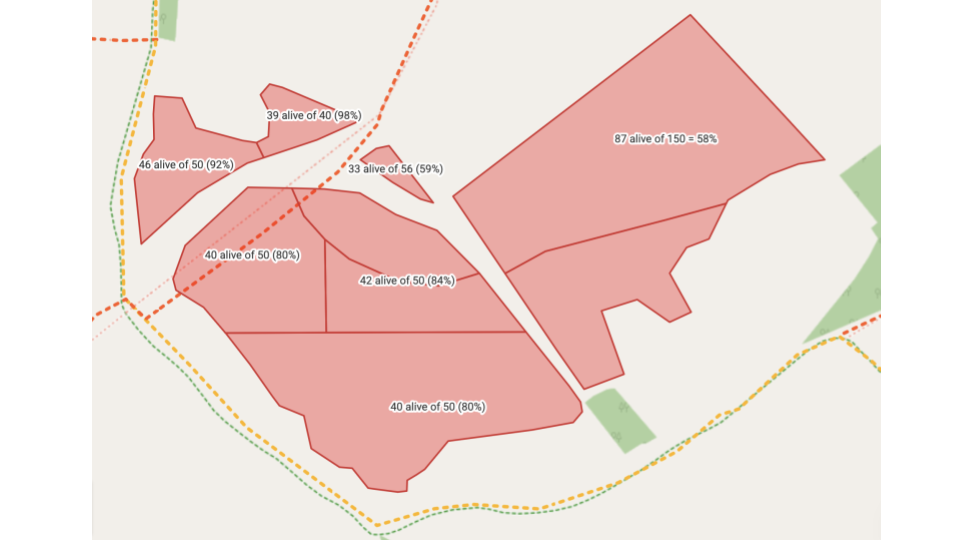
More thought is needed on how to continue working with contractors to ensure our high standards are met across all plantings, as well as the planting and maintenance plans taking into account sites or parts of sites that are exposed.
Nannerch really demonstrates that the line between success or not lies in care and protection - volunteers that love what they’re doing and feel a part of a site will care for it, and that care is reflected in the survival rate. The protection needs to come either naturally from the topography, or from us, in how we set out the planting and protect it.
Regional
Protect Earth has planted across 12 regions in the UK. However, the data available for the regions is not equal. One region has no site data available, six regions have data for only one site, and one region has only two sites. This makes it somewhat difficult to make meaningful conclusions about these regions, as with such a small sample of data, the sites could be outliers and falsely pushing the survival rate up or down. However, an initial analysis is useful to build on later, as more data becomes available.
Yorkshire & The Humber
Survival Rate: 95%
Planting Season Range: 21/22
This has only one site, so it could be an outlier. It had a good planting plan, is an ideal site near a river and with plenty of water available. The landowner is deeply involved and committed to the project. It was replanted in the 24/25 season with roughly 200 replanted by Protect Earth, plus some additional by the landowner. With an initial planting of 1227, 200 represents about 16.5%. Even with this taken into account, it is still a good survival rate, close to the target 80%. However any restocks in 22/23 or 23/24 are not accounted for. Other sites in the region may have done better or worse depending on the variables outlined in the best and worst performing sites.
Northeast England
Survival Rate: 77.5 %
Planting Season Range: 21/22 + 22/23
There are only two sites, so it is difficult to make a statement about the region, however both sites seem to have good landowner engagement. Neither were restocked in 24/25, but could have been restocked previously, contributing to higher success rates.
Southwest England
Survival Rate: 75.5 %
Planting Season Range: 21/22 + 22/23 + 23/24
The Southwest has the most sites, with 27 being planted in the last 4 years. Unfortunately 12 sites have no data, meaning that we have 55.6% of the sites’ data, potentially skewing the numbers and conclusions. However, 15 sites is still a respectable sample size and allows us to draw more solid conclusions.
The survival rate ranges from 50-97%, with most sitting in the range of 70-79%. There are quite a few sites in the 80-99% range too, more heavily weighting that end of the scale than the 50-69%. The southwest is well-known for its vegetative growth, and sitting inside the ‘temperate rainforest’ belt, it is conducive to native woodland.
None have been restocked in 24/25, however this doesn’t take into account any restocking for 22/23 or 23/24.
North Wales
Survival Rate: 73.0 %
Planting Season Range: 24/25
There is only one site, so this could be an outlier. The areas with the highest survival rates were naturally protected by trees and a hill, and planted by engaged volunteers. The worst performing areas were planted by contractors without engagement in the project outcome, in exposed areas.
Southeast England
Survival Rate: 70.6 %
Planting Season Range: 21/22 + 22/23 + 23/24 + 24/25 (most 22/23)
There are 11 sites in Southeast England, with two sites lacking data. That means we have 81.8% of the sites’ data.
The range of survival is 35-99%, and the sites are fairly evenly distributed throughout this scale. The data from the sites suggest a variety of reasons as to why they are performing well or not, as detailed in the best and worst performing sites - namely landowner engagement, and adverse weather. However a couple of sites have no reason as to why their numbers are fairly low.
Again, none have been restocked in 24/25, however this doesn’t take into account any restocking for 22/23 or 23/24.
West Midlands
Survival Rate: 70.0 %
Planting Season Range: 21/22
There are two sites in the West Midlands, however only one has data. Since there is only one site, it could be an outlier. The site we have data for has generally fared well, however rabbits in the hedgerow have meant that half the hedgerow planting failed, bringing the overall number down.
No restock in 24/25.
Mid Wales
Survival Rate: 68.2 %
Planting Season Range: 21/22 + 23/24
There are five sites in Mid Wales, and we have data for all five of these sites. This is still a small sample size, but large enough to start a meaningful analysis.
The survival rate ranges from 30-92%, with the 80-89% range having the most sites. The site with 30% survival seems to be an outlier, pulling the overall regional survival rate down. The 30% site is an exposed site (Cwmarirog, as described in the Worst Performing Sites section), and so it would seem that Mid Wales could generally be considered a good region, as long as the site is not exposed.
No restock in 24/25, but since they are earlier, could have been restocked to boost numbers.
East Midlands
Survival Rate: 65.0 %
Planting Season Range: 22/23
The East Midlands only has one site, so this could be an outlier. The lower rate of survival could be due to the fact that the site is quite wet, and no alder and willow were planted. The landowner also had additional trees planted, but no information on what they were.
No restock in 24/25.
Southeast Wales
Survival Rate: 63.0 %
Planting Season Range: 23/24
There are three sites in Southeast Wales, but we only have data for one site, again this could be an outlier, and it’s difficult to look at a region with one site. The site itself seems to have well-draining water and not had much rain. This could be why the survival rate is lower, but it is difficult to tell.
No restock in 24/25.
South West Wales
Survival Rate: 54.5 %
Planting Season Range: 22/23 + 23/24 (most 22/23)
There are four sites in Southwest Wales and we have the data for all of them. It is still a relatively small sample size, however it is enough to make a start. The sites here are at opposite ends of the scale, with two sites at 25% and two at 83/85%, strongly indicating that it is not the region indicating success. At the two sites with a 25% survival rate, bracken was named in both as a reason why saplings had not got away, being choked out, and also cattle in one of them. At least one of the high performing sites has an actively engaged landowner, indicating that where continued care is given in this region, it can be very successful.
No restock in 24/25.
Perth and Kinross
Survival Rate: 15.0 %
Planting Season Range: 24/25
Here again we have just one site in the region. This is the worst performing site, which is why the region has performed badly. It could easily be an outlier, and indications are that the site has suffered because of issues around exposure to wind on the site, and adverse weather.
Northwest England
There is no data available for the two sites in Northwest England.
Regional Conclusions
The South seems to do particularly well, but the wide variation within regions would strongly indicate that the factors raised in the best and worst performing sites would demonstrate whether a site is likely to be a success or failure. The outcome could be exacerbated by regional influences - success being more likely in damp, mild regions like the Southwest, and failure being more likely in regions suffering from severe and adverse weather events.
With such a small sample size for most regions, it is impossible to draw meaningful conclusions, but this can be built on over time to look at trends.
The lack of data over restocking will mean that this conclusions aren’t necessarily accurate, and can be updated once the data becomes available
Spotlight: High Wood
High Wood was taken over by Protect Earth after being managed as a commercial timber plantation, with Douglas Fir, Sitka Spruce, and Western Hemlock dominating the landscape for decades. Since then, we’ve cleared out the timber trees in successive waves to make way for native woodland to take root and grow, all with the advice from our ecologist and forester, folks at the Woodland Trust, and with permission from the Forestry Commission.
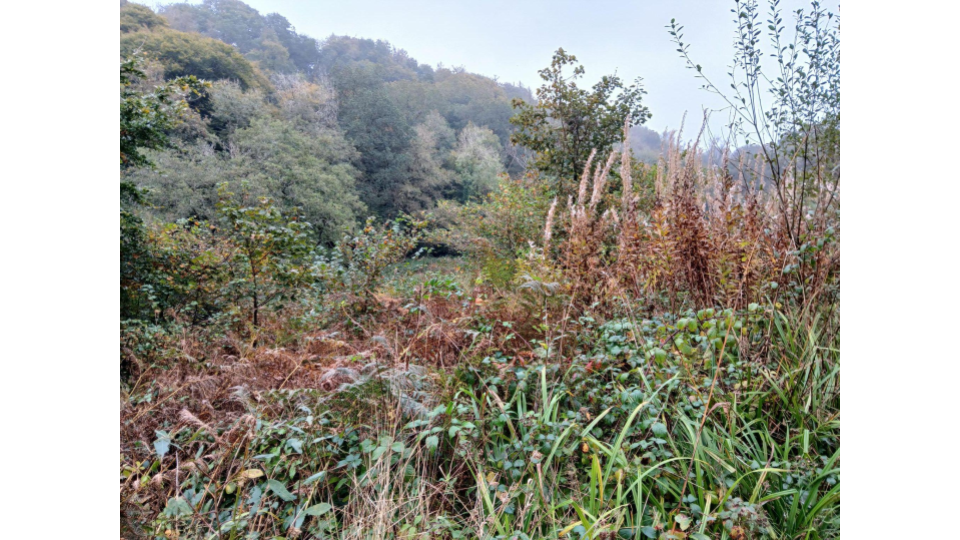
The first planting took place in January 2023, with a mix of trees like oak, beech, alder, aspen, Cornish elm, wild cherry, wild service, goat willow, silver birch and rowan, and shrubs like hawthorn, hazel, blackthorn, field rose, guelder rose and spindle. Open glades were left, and hardy alder and aspen were planted in the damper areas and around the edges of clusters of trees to act as windbreaks.
November 2023 and January 2024 saw some more conifer clearing, made up of local volunteers, many of whom are a regular part of work parties - this kind of engagement and empowerment is a core part of the way Protect Earth works, both for the trees, and for the local communities. Both benefit.
Surveying this year was difficult, as bramble had taken over a lot of the site. It’s estimated that 50% had not survived, but for every dead tree, three willows had taken its place. With this level of regeneration, it’s not necessary to restock. However, the bramble should be cut but to ensure that those trees that have survived so far continue to do so.
Planting Seasons
There have been four planting seasons so far, with survival rates becoming more reliable the further back in time they are - the younger the planting, the more vulnerable it is to being affected by pests, drought, etc.
Planting Season 21/22
Survival Rate: 77.4%
There is a wide range of survival rates, from 50-95%. There is a mix of regions all across the country, and out of the 15 sites for this season, we are missing two. This can give us a meaningful look at the planting season. The median is 72.5% and the mode range is 70-79%.
The lowest performing site at 50% is pulling the overall survival rate down, as the rest are all above 70%. Without this site, the average survival rate would be 79.7%. The reason this site has only a 50% survival rate is because sheep were allowed to eat what had been planted, and possibly deer have been in there too. Going forward, landowner agreements for sites that we do not directly manage have been tightened to ensure that this doesn’t happen again.
Overall this planting season was very successful, and considering that four years have now passed, these numbers are unlikely to drop, unless there is a country-wide weather catastrophe.
Planting Season 22/23
Survival Rate: 72.7%
The survival rates range 25-99%, encompassing both the best and worst performing sites. There is a mix of regions again, but largely focused on the south, and out of the 21 sites for this season, we are missing eight. This could seriously change the conclusions of this season, however 13 is still a decent sample size. The median is 62%, and the mode range is 80-89%.
The best and worst performing sites balance each other somewhat, but the worst performing site is more of an outlier than the best. The mode range at 80-89% indicates that despite having a lower average, this could be considered a better planting season than 22/23.
Planting Season 23/24
Survival Rate: 65.8%
The survival rates range 25-97%, again with best and worst performing sites. And again there is a mix of regions, but largely focused on the south, and Mid Wales. Out of the 20 sites for this planting season, we are missing data from 8, putting at roughly the same level as the previous year for reliability of data. The median is 61%, and the mode range is 50-59% and 90-99%.
The data shows that there is an overall lower rate of survival in 23/24 planting season. This indicates that there could be something happening with the climate, since a more recent planting should have higher rates of survival than previous years, simply from not having succumbed to more exposure to adverse weather and pests.
The southeast was hit by Storms Elin and Fergus in December 2023, Storm Henk in January 2024 hit central and southwestern England and Wales, followed closely by Storms Isha and Jocelyn, so these may have had an impact nationally on plantings.
Planting Season: 24/25
Survival Rate: 41.1%
The survival rates range 15-73%, with two of the three sites with data being in the worst performing sites list. The regions are spread around the country, but with such a small sample size, and encompassing the worst performing sites, it is difficult to draw meaningful conclusions about this planting season. We are missing data for one of the four sites planted in this season.
The analysis for the 15% and 35% site has already been done in the Worst Performing Sites section. The overall numbers are extremely disappointing, however considering the sample range and individual reasons for poorly performing sites, it’s difficult to say whether there is a ‘trend’ for this planting season, or simply bad luck on the specific sites that were planted during this season.
Planting Season Conclusions
Again, restock rates are not available for previous seasons, so these numbers could change drastically when looking at original survival rates and how much has been augmented by restocking. While numbers seem to have decreased year on year, 21/22 and 22/23 are actually comparable (possibly due to restocking). The 23/24 planting season is lower, with the possibility of weather affecting the survival rates, but it is difficult to say without a more in-depth investigation of country-wide survival rates for other planting projects. The 24/25 season is extremely disappointing, but due to the small sample size and site-specific reasons for poor survival, it may be a statistical anomaly. Again, this could be quantified with a more in-depth investigation.
Spotlight: Goytre Wood
Protect Earth owns 28 hectares of land near Lloyney at Goytre Hill. There was already valuable habitat at this site, which has species such as skylark, whinchat and tree pipit, which we are working towards maintaining and improving. The plan is to create a woodland here that will benefit wildlife including declining bird species such as the pied flycatcher and wood warbler. In this environment, local people will be able to come and enjoy the abundance of life and diversity, knowing that this beautiful place is also sequestering carbon.
The first planting took place in February 2024, with 600 saplings of silver birch, hazel, hawthorn, holly, crab apple, wild cherry, sessile oak and rowan. This was hugely augment in November of 2024, with a further 11,625 saplings, with more of the same, plus alder, aspen, goat willow, elm and bird cherry.
The survival rate is disappointing at only 54% - that’s a lot of investment of time and money that has unfortunately been lost. The survival rates in different areas vary from 38% at the lowest to 76% at the highest.
As we’ve seen across many other sites, where the exposed areas are, there we find the lowest survival rates. On the south facing slope, the hot and dry spring and summer had had an intense effect. Any rain that did fall evaporated in the long grass before reaching the soil. Survival rates were 38-55% here.
Goytre Trump, the east facing slope was a bit better off - with some shaded areas, there was a better overall survival rate of 60%. The northwest strip, which was protected by an existing area of ancient woodland, and with a stream to water it did much better. The bracken shaded the saplings, though this could be an issue in the future. Survival rate of 76% in the shade and damp.
There is hope that some of the saplings that look dead have survived at the roots and will send new shoots up come the spring, however we will replant the worst sections, at about 20% restock. Alongside that, we will be using hemp mulch mats on the south slope to help keep the grass down and to help the soil to retain more moisture, and for more water to reach it.
Dedicated volunteers will help to ensure that the new planting survives at higher rates, and to keep an eye on where needs the most intervention to ensure survival.
Conclusion
Despite the missing data for this year, there are some key factors that can contribute towards ensuring a good survival rate. The engagement of the landowner with the project is key - those sites with proactive landowners, who do surveys and actively engage with the Protect Earth team consistently show good survival rates. Those that care, that are out looking at the planting regularly and responding to any changes can ensure that the planting will get away. One site that did particularly well was actually watered by the landowner during a drought, which no doubt contributed to their survival.
Protection from being eaten by animals is key - sheep, cattle, deer and rabbits were all named in various surveys as having caused damage. Consideration to protection, and a commitment from the landowner to not allow grazing in the area is vital to ensure success.
Exposed sites often struggle - a greater consideration for the site, and what could be done to protect whips and saplings in exposed areas could see an improvement. Sites with dominant species such as bracken or Himalayan balsam need to create and implement a management plan to ensure that the trees can get away and not be choked out.
To get a deeper and more reliable understanding, data from the rest of the 19 sites is needed, as well as the restock data from previous seasons. Once the data is in, these conclusions can be looked at again to see whether they hold up in the light of new data, or need to be revised.
To ensure an equality of data from each site, a standardised methodology of surveying and reporting should be implemented, making it easier to assess the reason for good or bad survival rates.