
Carmageddon - how we're paying for bad automotive karma

How many memories do you have with cars? Their presence is ubiquitous in our lives and has been for decades.
Separate your positive automotive memories from your day-to-day experiences with cars and driving, and what does it make you think of? Stress over other bad drivers, being late because of heavy traffic, unease when you think of that monthly car payment? Guess what? You are not alone. We are all in this dimension - that author Daniel Knowles has dubbed ‘Carmageddon’, also the name of his recently released book.
This book on the rise of the car and its dominating takeover transforming our environments was written when there were, ironically, far fewer cars on the road in living memory - during Covid. But, the time allowed Daniel to consider his thoughts and clarify with sound research.
The car’s infancy and adolescence were rough years with the public opposing automobiles - cars were the playthings of the rich and famous. But, a series of circumstances - from intense and well-funded lobbying to rich politicians pushing for cars so they could drive more freely to a decline in resolve, saw the car move from the demon of the road to the star of the road. Now that the star has supernova’d, its explosion is impacting life and our lives in many ways.
The environmental impact of cars is staggering, from sourcing the materials to manufacturing, getting a car to a dealership, and then getting it on the road. The road, as we know it today, is a direct requirement of the car. There are approximately 1.45 billion vehicles in the world.
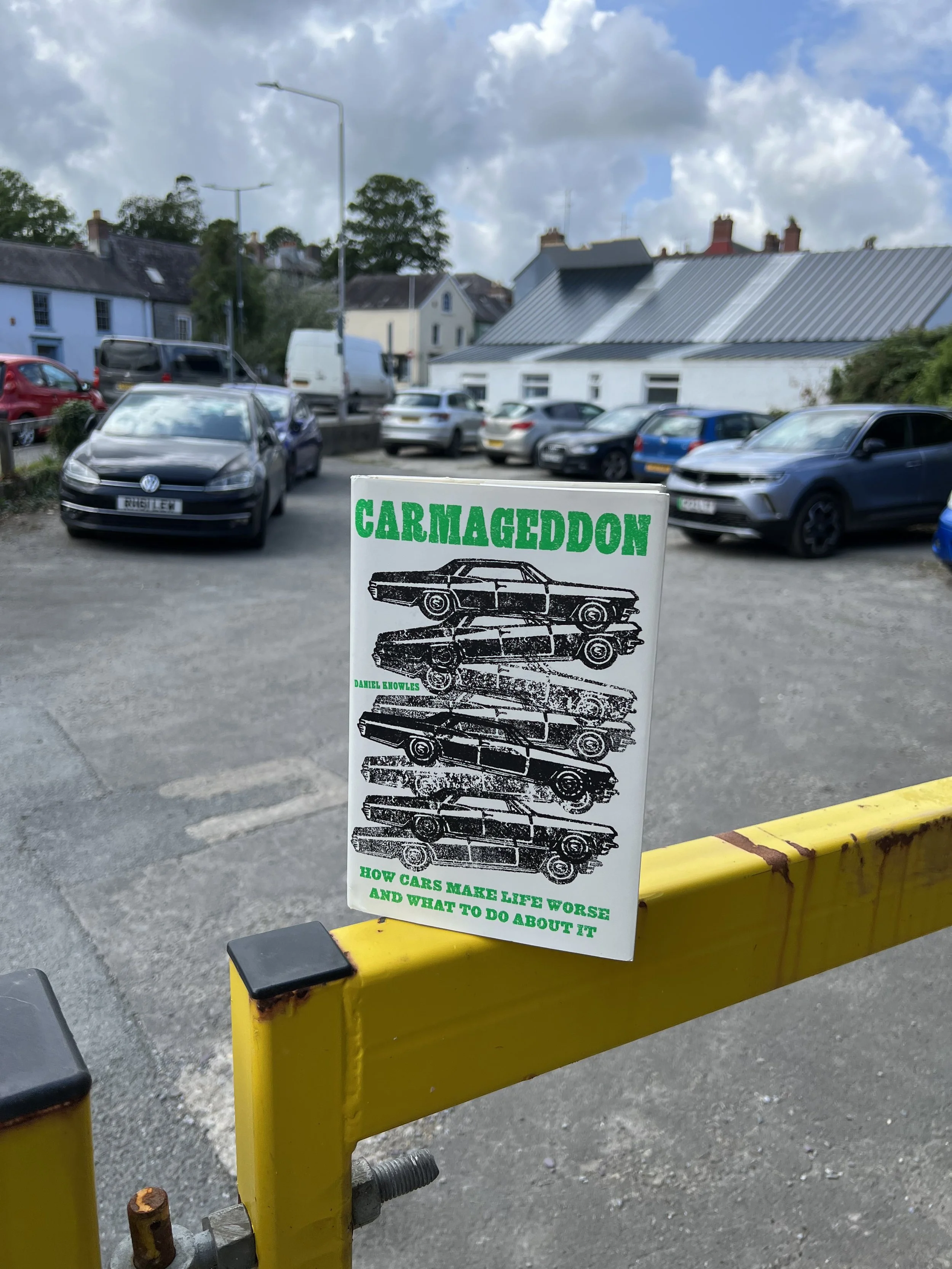
Daniel points out a whopping statistic - in Houston, Texas, there are almost 200 million parking spaces, which, he further elaborates, is equivalent to the size of ten Parises! Imagine the benefits if this space could be woodland. Imagine the reaction from people in Houston to suggest such a thing. Despite the criticism that would surely come, how many people have questioned or criticised the creation of so much environmentally damaging stuff? You’ll be looked at like you’ve two heads if you suggest transforming so much space into repairing woodland, yet that scale of transformation has been allowed to happen again and again worldwide in the name of the car.
This book by Daniel Knowles is a global perspective on the car and its impact. But, through all the statistics pointing towards a smoggier tomorrow, Daniel also does elaborate on oases around the world where the car is being disincentivised. Smartly, he doesn’t advocate we rush towards doing all these things at once - lest the above example of outright criticism and dismissal is the end goal. Instead, the approach is to take what’s been done elsewhere that would surely work locally and start with that.
All we can hope for is a more conscious use of cars and an awakening to the possibility of greener, healthier spaces if we pave over less of a finite planet.
Carmageddon, published by Abrams Press and written by Daniel Knowles, is a great, great read. Knowles is also an informative speaker and has made several podcast appearances to listen to next time you’re driving.
Get your copy at Amazon.