
Goytre Wood update: A Welsh woodland in progress

Over the past few years, Protect Earth has been working on creating a woodland in Powys, Wales. Overlooking the Radnorshire hills sits the once overgrazed slopes of Goytre Hill, near Knighton in Mid-Wales. You’ll know the area if you’ve ever trotted along the eastern end of the Trans Cambrian Way. For us this is an important site for not only flood mitigation and the carbon and biodiversity benefits that come with restoring woodland that historically covered most of this valley, but also as it’s the first woodland we’re creating on land we actually own.
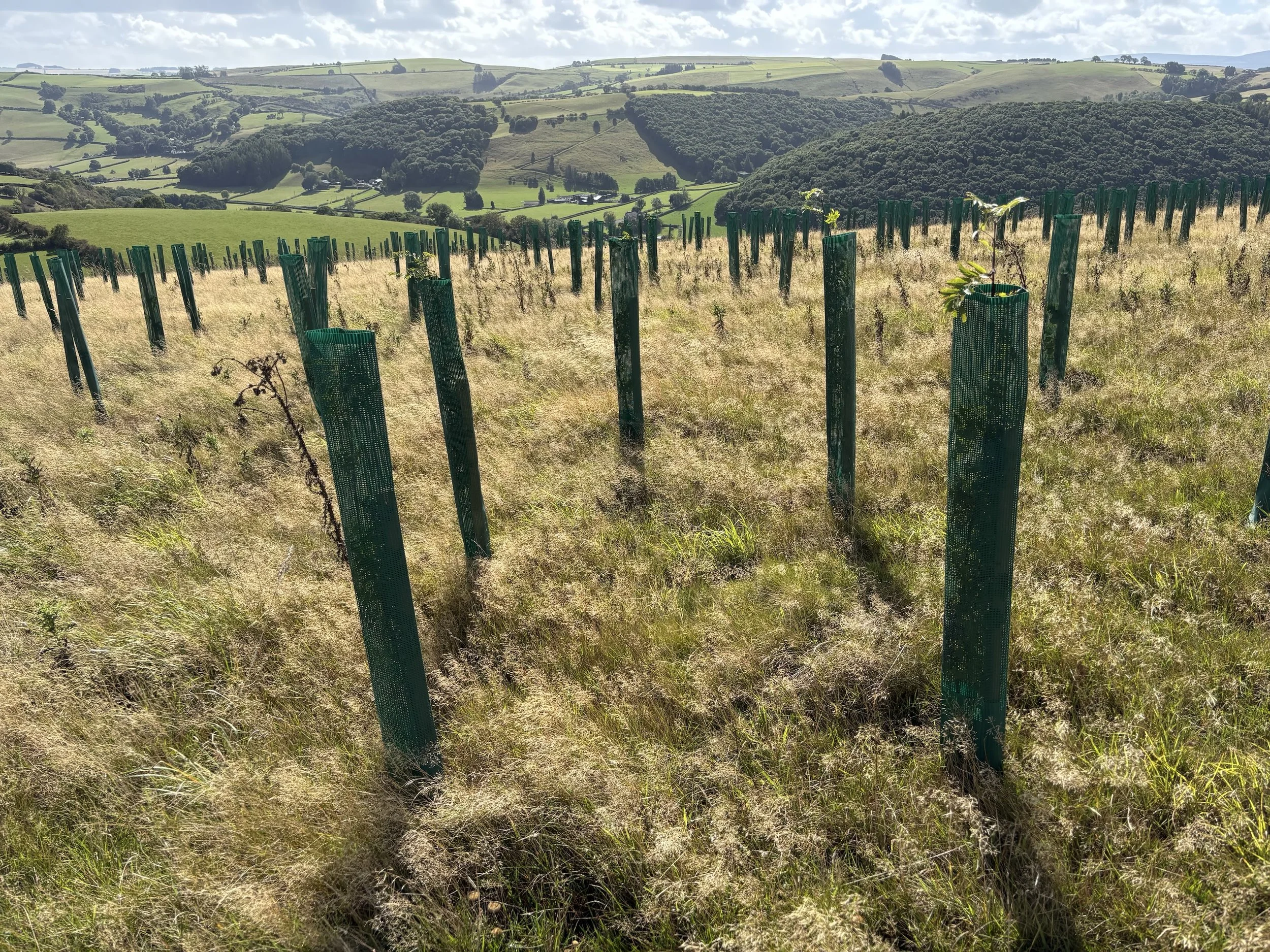
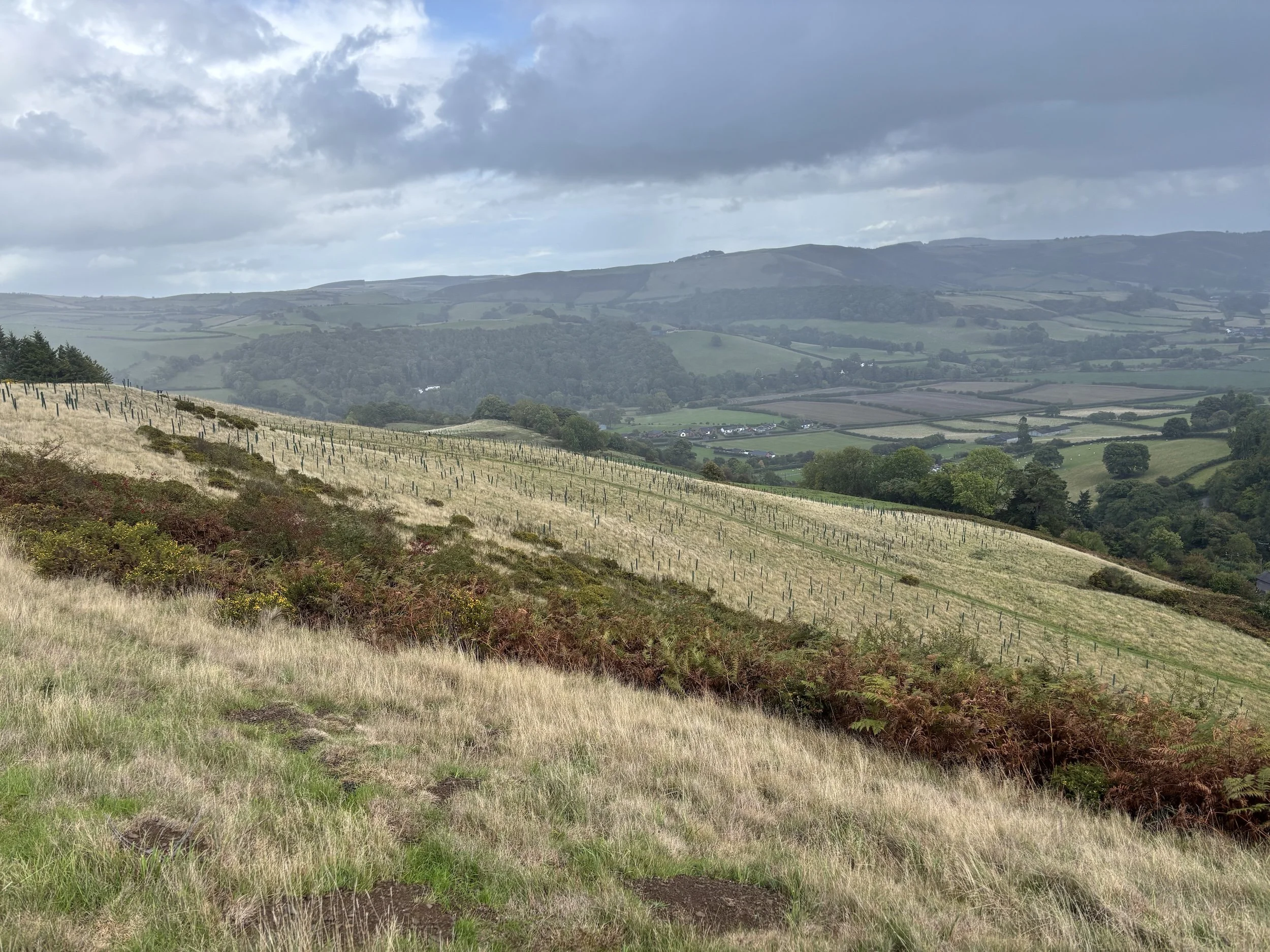
The team has been hard at work with volunteers and contractors planting and surveying this 70 acre site skirting the River Teme. While things aren’t going as well as we might have hoped, planting at Goytre Hill has been a huge achievement for us and we’re confident that things are still on track. Biodiversity is already on the uptick, and we’re not done yet.
The permissions for planting took two years to get, but having the entire local community on board helped. Once the work was approved, the initial survey visitations were complete, we had hoped to plant around 14,000 saplings of Sessile Oak, Hazel, Holly and Hawthorn, with Rowan and Birch trees dotted all along the edges. We ended up just shy of our initial goal with around 12,000 native saplings planted across the site, after discovering skylarks nesting in one of the intended areas and of course deciding to give them plenty of space. Each sapling is protected by a sturdy tree guard, and steadied with a wooden steak.
Checking Goytre Hill saplings
After a long summer of checking on other planting sites, at the turn of September it was time to get counting, to see how the saplings were holding up after their first summer.
Sustained by service station coffee and hastily-assembled sandwiches, a team of four deputies and a few volunteers set out for a hike up Goytre Hill with a mind to straighten up the tree guards and count the saplings that had taken root, marking off any that hadn’t made it. With that information we’d be able to outline our next steps for the site, depending on the overall sapling survival rate.
It took a full weekend of sweeping back and forth to survey the site, during which we got a good feel for the promise Goytre Hill holds. Parcel by parcel, it became clear that there’s a lot of impressive growth going on. We’ve got bushy Oak saplings almost bursting out of their guards and plenty of Rowan already poking their lush green leaves over the top – even some that rival the height of our very own passionate, if a little vertically challenged, Protect Earth Chair, Phil Sturgeon (sorry Phil).
We even spotted a few rogue Oak saplings toughing it on the windy hillside without any support from us, which is a clear indicator of the wonderful growth potential of the site now that grazing has stopped in these areas.
Along the north-west strip – which backs up against an established (but sadly miniscule) sliver of ancient woodland – we hopped a fence into a dense swathe of bracken to check some saplings nestled in the undergrowth, sleeves tucked tightly into our gloves. Thanks to the wall of woodland and lush ferns providing shade and wind protection, combined with our sturdy tree guards holding space and light for the saplings, we noted some smashing growth.
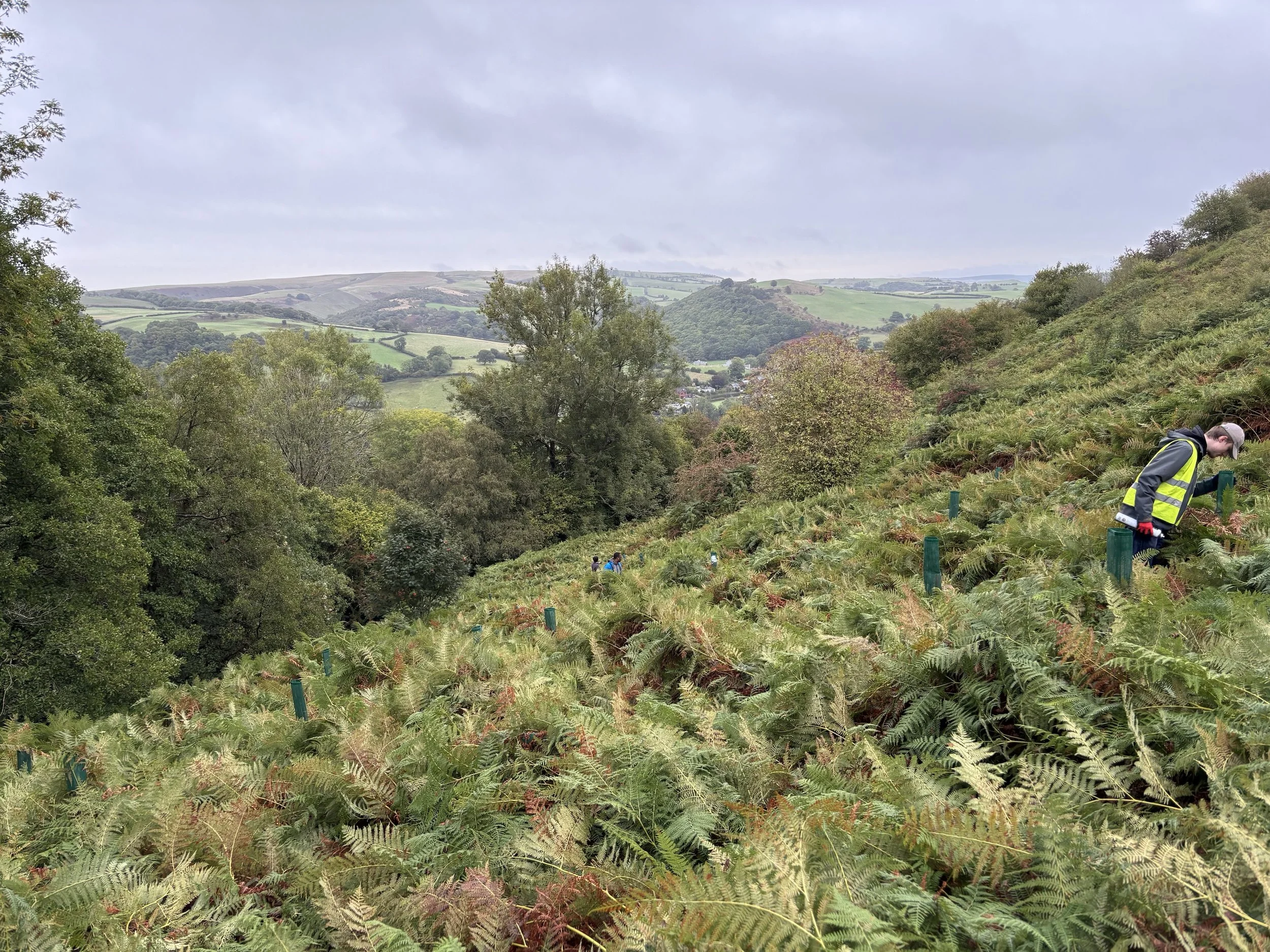
It just goes to show how important the tree guards are, as without them these saplings would likely have been smothered in bracken and shaded out entirely. The guards kept a ray of light above them, and led to the best survival rates for any parcel on the site.
Many of the Holly saplings I checked over were struggling, sadly, since it tends to prefer the wetter, temperate weather that climate change is pushing us away from. In particular I noticed a lot of dead saplings along the steeper south slope of Goytre Tump, likely owing to the gradient harbouring much higher drainage rate than the flatter areas. Pair that with an intensely hot, dry spring/summer and you start to see why these more exposed areas had a tougher time of it. Between the steep slope helping water flow away, thick grass keeping it from reaching the sapling roots, and south facing slope increasing sunlight leading to more evaporation, the south slope was having an incredibly rough go compared to other parts of the hill.
The results are in
When the survey finally wrapped up we were looking at an overall average year 1 survival rate of 54%, with some parcels touting survival rates as high as 76%, and some as low as 38%. While that’s far below our goal of 80% survival by year 5 it’s only a minor setback in the broader plan to increase biodiversity in the area.
The likelihood is that many of the saplings that appeared dead have “dead-headed” themselves due to the dry, hot summer, and should spring back from the roots. We’ve seen this time and time again, across our various sites but it’s not a given, so we’re taking action.
Where do we go from here?
“We can fix it,” says Phil, offering a hearty salute. The plan is to replant the sections with the lowest survival rates across the site. That doesn’t mean ripping up the old saplings, either. New saplings will be added beside those marked as dead, to give any failed saplings another chance to establish themselves. That should add another ~20% to the survival rate of the struggling parcels – more if the dead-headers decide to stick with us.
The addition of hemp mulch mats on the steep south slope should improve things, too. These help limit the competition from grass and shade the immediate area from direct sun to give the saplings more chance to soak up water before it drains away, or evaporates in the heat.
We’ll also be dipping all new saplings in a mycorrhizal fungi root dip to give them a chance to root deeper into the soil, which is something that has helped drastically improve the success of replanted saplings across our other drought-hit sites, drastically boosting survival through the next summer.
With planting season at our door, we’ll soon be trekking back to Goytre Hill. Hopefully, with a little help from local volunteers and our amazing neighbours, we’ll be expecting a massive boost to survival rates for next year.