
Misconception: "Rewilding" is better than tree planting

The term “rewilding” has received a lot of attention in the last few years, covering from letting your grass grow a few extra months supporting bees and insects, to reintroducing wolves.
The proliferation of this term causes a lot of confusion. Still, one common meaning is: instead of planting saplings, we should leave the land alone, allowing it to return to an ecosystem thriving with plants and animals through a natural process. Some consider rewilding superior to tree planting, and many think “tree planting organisations” are “doing it wrong”. The truth is that rewilding and tree planting are all tools from the same toolbelt and can be used separately or together to great effect.
This sort of rewilding is more academically known as “natural colonisation”, and it can work brilliantly when the conditions are right:
-
There needs to be a source of native trees nearby, with mature trees that can produce seeds, or many seeds in the soil already, and
-
There cannot be too many browsing animals (deer, rabbits, or livestock).
And when the above conditions are in place, natural colonisation is exceptional and beautiful to watch.
However, there are two factors thwarting rewilding’s ability in the UK:
-
Great swathes of the UK haven’t the ecosystems in place to allow natural colonisation to take place, and
-
Climate change is impacting environments faster than our remaining fragile ecosystems can handle.
According to Forest Research, thirteen per cent of the total land area in the UK features woodland. It gets even worse when you look at the stats for specific types of woodlands. The UK once had up to 20% temperate rainforest coverage! Today, that magnificent type of woodland is less than 1% of land use in the UK. Nothing comes from nothing, and with the sparsity of woodlands coverage, we can’t expect natural colonisation alone to be very effective.
If there are not enough native plants close to a space suitable for natural colonisation, leaving the land alone will not accomplish much, certainly not on a timescale relevant to the urgency of the climate and biodiversity crises. Leaving the land alone can even be a hindrance, as invasive species can take over the space like rhododendrons jumping from nearby gardens to shade out any seeds that do manage to find themselves in the space.
Human intervention is required to try to reverse the damages we’ve done to our native woodlands, reducing them from mighty forests to isolated pockets being overgrazed and browsed to within an inch of their life.
How Protect Earth use natural colonisation and tree planting together
Tree-planting organisations use natural regeneration in interesting combinations. Sometimes a project will be entirely natural colonisation with no tree planting, but planting close to woodlands with lower stocking densities can combine the best of both techniques.
For example, at High Wood, our ancient woodland in Cornwall, we have some clear-felled areas that will not establish a canopy in any sort of relevant timescale. Through controlling the stocking density, we can leave larger gaps between what we plant to create clearings so that if seeds (either in the soil already or brought over by jays, squirrels, etc.) want to give it a shot to establish themselves, they can. We can expect Oak, Ash, Willow, Holly and Hazel to pop up naturally. With low-density planting, we can bring back Cornish Elm, Plymouth Pear, Wild Service Tree, Yew, and Hornbeam, the latter of which will be far more tolerant of high temperatures expected in upcoming years.
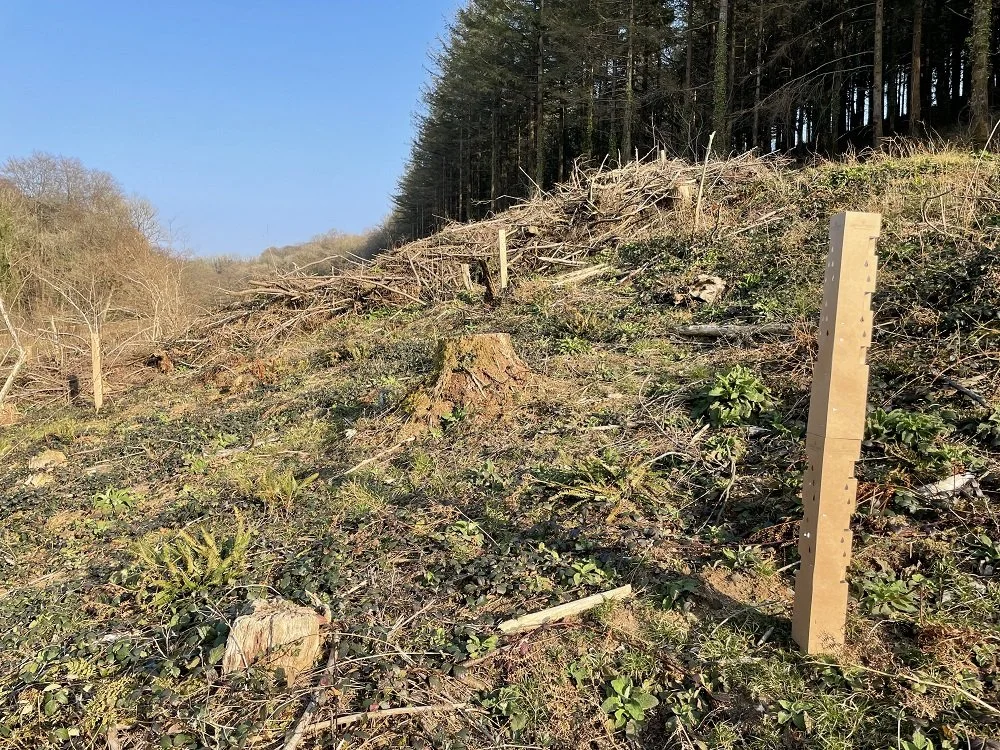
At various other sites, we’ll be planting next to an ancient woodland with the same approach: reintroducing native species which are missing and leaving space for other species to appear with the low-density planting. Combining both methods of rewilding and tree-planting boosts an area’s recovery time, making a more fully functional and biodiverse ecosystem, which is the armament required to tackle climate change.
To sum up
The short answer is that tree planting and “rewilding” are not black and white, neither is “better” than the other, and they are not mutually exclusive. They are available tools for woodland creation, and are frequently used together when it makes sense, but with especially low levels of woodland coverage in the U.K., and low levels of diversity in many of those woodlands, it is unsurprising that planting is involved more often than not.