Misconceptions: Reforestation is taking valuable land from farming

Reality: Groups like Protect Earth work with farmers to increase biodiversity on their land, which is proven to increase crop yield and reduce the costs of caring for farm animals. When we buy land, we look at taking on land that is not productive. We have no obligation to make money every quarter, meaning it makes more sense for everyone to work together, us planting less productive places and letting nature take its course over several decades.
This post is written by Phil Sturgeon, co-founder and Chair of Protect Earth, and is part of a series of posts discussing the grey areas in tree planting and forestry.
There is a common narrative in the media that London based hedge-funds are buying up entire Welsh farms (including the buildings) and stuffing the fields full of whatever will get the most carbon credits for them to sell, with no consideration towards whether they’re planting what’s most suitable for the soil. The narrative continues saying these hedge-funds-cum-mafiosos care nought for local communities that could be affected and make no attempt towards creating local jobs.
Some of that may be true, but not as much as some newspapers would make you think, as we can see from the records of how much tree planting is being done across the UK.
That is a commonly spun narrative. Now, let’s break this down to debunk the misconception. To do so, we’ll look at how many available acres there are in the UK - including how many acres are used for agricultural activities and what the government’s annual planting target is, what land alternatives there are to planting on agricultural land, and briefly, on how increasing a farm’s biodiversity can actually reduce operational costs and increase profit - meaning there’s value for farms to become greener, not a threat at all (when done correctly)!
Acreage available and agricultural
The United Kingdom of Great Britain and Northern Ireland comprises 60.1973 million acres.
Over the whole United Kingdom, 76% of the land is agricultural (you are welcome to work out what 76% of 60+ million acres is; I’m still trying to imagine 60+ million acres).
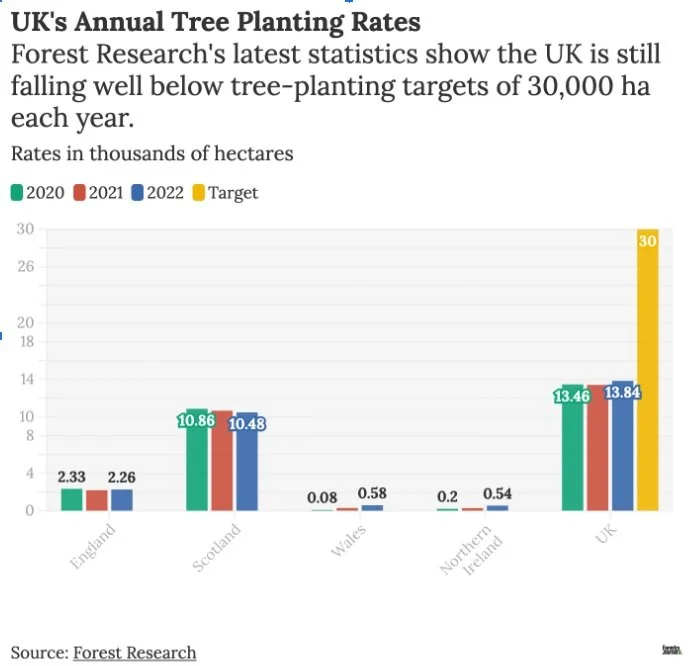
According to Forest Research in 2022, woodland covers only 13% of the total land area in the UK, 19% in Scotland, 15% in Wales, 10% in England, and 9% in Northern Ireland. Across the UK, the devolved governments have agreed to the target of 30,000 hectares of additional tree cover each year until 2050, which is 0.16% of the total land in the UK each year.
Let’s return to the misconception of London hedge funds looking at planting hedge fields in Wales to leverage carbon credits to pay themselves and shareholders even more eye-watering amounts of money.
540 hectares are planted with trees yearly; much of that is existing landowners growing trees on their own land (we know, we work with them to help them do it). Even if 100% of this 540 hectares was being purchased for tree planting, and all of it was agricultural land, there are 1.5 million hectares of agricultural land in Wales (source: gov.wales), so that means that at most, the annual rate of Welsh agricultural land is being converted to woodland each year is 0.054%, with no sign of ramping up any time soon.
Farms are not the only spaces that would benefit from more plants
That is true! Farms shouldn’t be the only types of property and land that benefit. What about your neighbourhood, and parks, and schools? We’re not talking about so many trees that it’s impossible to move. But, certainly, these spaces could absorb more green without even noticing. And, would benefit from more green, as would the space users!
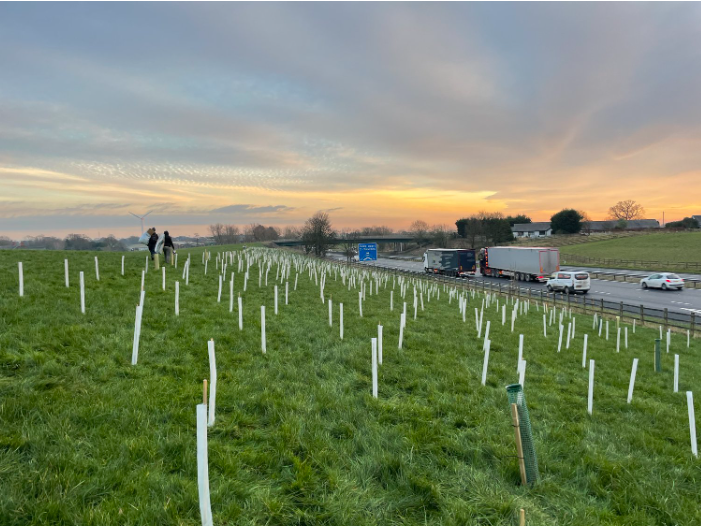
We’ve even had the harrowing experience of planting trees along the side of the M6 - with all the pollutants pumping out from cars day after day, the side of a motorway is no place for a farm producing food to be served on your plate. Trees along a motorway will at least make a dent in clearing some of this pollution.
There are benefits to increasing agricultural biodiversity
It’s also incorrect to assume that tree cover and food production cannot be combined.
Agroforestry has a long history across the UK but was scaled back by various government initiatives to a point where, recently, if a hedgerow grew too tall, someone was going to get a huge fine. Thankfully, things are moving in the right direction.
Working with groups like Farming & Wildlife Advisory Group South West, FarmEd, various agricultural consultants, and farmers directly, helping them increase tree cover through woodlands, hedgerows, shelterbelts, and field trees. These methods can provide shelter for livestock, reduce soil erosion, and provide farmers with diversified income.
Woodlands are rarely planted on the most productive soil, either. For example, on a 400-hectare farm, we planted the least accessible, boggiest, least productive 4 hectares they have. Planting 1% of a farm without harming food production is something many groups are working with landowners to do. But using the generalised standard of 2,900 trees can be planted on an acre, and the UK has 60+ million acres, of which 76% is agricultural land. That would equate to 45.75 million acres of agriculture. One per cent of that converted to agroforestry would be 4.5 million acres, equating to more than 13 billion trees being easily absorbed into the UK.
Of course, there are all sorts of ways to derive value. One farmer we planted with even decided to give up some land that was barely being used for a community allotment, and it’s an idea I would love to recreate on our land in the future. Leaving an acre or two to allow the community to grow their fruit and veg would be a huge win for emissions reductions while meeting the trifecta of priorities: climate, biodiversity, and community.
If you’re interested in doing this on your farm, please get in touch, and we can help you navigate all the paperwork.
Along with the smaller-scale piecemeal woodland/habitat creation, there needs to be larger habitats created that can serve as wildlife sanctuaries. Many of these will be former farmland, but Protect Earth (like most woodland creation charities and community groups) are looking for low-quality farmland, based on the grading system of 1 being the most productive and 5 being the least productive. Some of it is also classified as “Less Favourable Land”, and the government pays the landowners grants to account for the fact that it’s very difficult to make a direct profit off this land. If somebody wants to sell that land, taking it off their hands and hiring a local site manager to look after it seems like a win-win for jobs, biodiversity, carbon sequestration, flooding reduction, and saving the taxpayer money (through eliminating reliance on grants that taxpayers pay).
It’s also important to realise that while we import 45% of our fruit and vegetables from countries with extensive industrial greenhouses (Netherlands) or warmer climates (Spain), we also import 77% of our timber. Some farmers are choosing to turn land that’s not productive for food into land that is productive for timber. That’s not something Protect Earth does, but it will be part of that annual 30,000 ha of tree cover increase.
To sum up
So, to recap this complex misconception: tree cover is planned to increase by 3% in England (update: targets shrunk to 2% by the Conservative government in January 2023), which is not all going to be farmland, will not necessarily reduce food production, could improve food production, and can help farmers switching from grazing to timber. When land is changing hands, it’s often the lowest grade land being bought first to avoid impacting food security, and community involvement and job creation is a primary goal for some groups, even if a few hedge fund investors did decide to get involved too.