
More Trees, More Biodiversity: Recapping Protect Earth's 2023/24 Season

Close to the beginning of the 2023/24 planting season, we shared with you what we expected to achieve over the season. Remember?
The planting season has now ended, giving us a chance to tally the figures and reflect on another year in which the community has come together to create more native broadleaf woodlands to encourage and increase biodiversity.
Let’s quickly recap our intentions at the beginning of the season before we talk about what was planted and how it all contributes to Protect Earth’s goals.
What Protect Earth thought we’d achieve during the 2023/24 season
Before the season began, we estimated that the UK would have 31,800 more saplings. That target represented a 24% increase from the previous season’s achievements.
Not only does this show growth in the right direction, but our time was going to be consumed with other woodland maintenance work like conifer clearing, which we had not done in previous seasons.
2023/ 24 looked like our biggest year, with significant tree planting increases and balancing our time restoring natural habitats.
Another point of early season excitement was that close to 76% of what was projected to be done was on land owned or long-term leased by Protect Earth. Here we could produce detailed woodland creation plans to restore long lost woodlands and maximise biodiversity.
What Protect Earth achieved during the 2023/24 season
As the season began, we projected we would plant 31,800 trees and hedging. After reviewing our projects, we exceeded that forecast by planting 32,754!
What’s exceptional about our planting success this past season is that it did not resemble how we thought the season would roll out when we initially projected ~30k! That projection was based on two big projects accounting for 76% of what we thought we’d plant. Both of these projects have been delayed to the 2024/25 planting season due to slow progress through government approval.
From when we first shared our season’s plans to April, when our planting season wrapped up, we were involved with projects adding up to 32,754 plants landing in terra firma. Twenty-four per cent of what was planted constituted hedges—which we’ll discuss later as developing hedgerows, a metric we have prioritised only this year—and the remainder as shelterbelts and woodland.
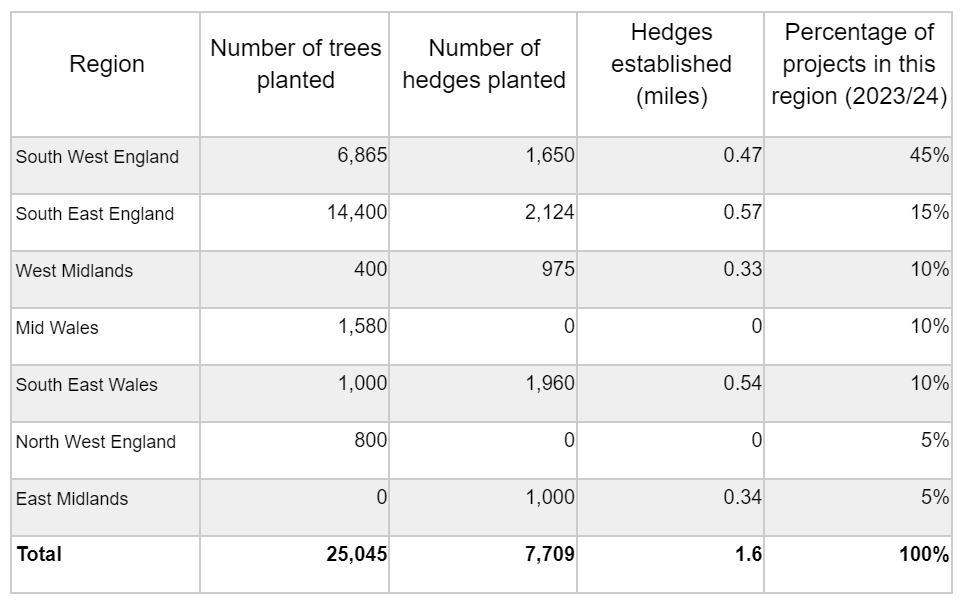
Our 2023/24 planting footprint witnessed most of our planting activities in England’s South West, which absorbed 45% of everything we did (equivalent to around 14.3k new plants). The South East had 15% of our projects - or around 4,793 new saplings. We planted 3,195 in the Midlands, in Mid Wales, and South East Wales, for a total of 9,585 saplings being planted in these areas. The North West of England and the East Midlands took the remaining 10% or 3,195. See the table below.
During the past season, Protect Earth revised our metrics, broadening what we’re measuring. Again, only planting trees isn’t the only thing we can do, so we have broadened our horizons to achieve a higher rate of biodiversity on our projects and with everyone we work with.
Land Under Direct Protect Earth Management
During the 2023/24 season, Protect Earth did not increase the land we owned or have under a long-term lease. But it wasn’t through lack of trying!
Crowdfunding allowed us to make two offers for new land—and we are grateful for the community’s support. In both cases, we were outbid, which is part of the process. While it takes the team a little time to readjust after the excitement builds around an auction, we are now looking at what can be done to ensure a higher likelihood of s/uccess in the future.
As we said above, land ownership has several benefits for us all. Principally, it ensures that the space is protected for the long term, allowing us to create and manage the best habitat for wildlife.
Ancient Woodland Restoration
High Wood has seen more work over this last season—the removal of 900 tonnes. Having been embraced by the communities around High Wood, we are setting up monthly work parties so people can get outdoors and participate in this woodland’s restoration and maintain access for all hikers, walkers, horse riders, bikers, and dog walkers to enjoy the spaces.
The two remaining projects we keep hinting at that would have seen additional woodland restoration are both in Wales. We own one site and have one under a long-term lease. We had hoped all permissions would have been granted for these projects this year. But we shall have to hope for the 2024/25 season to start planned work. Both of these projects’ plans incorporate open glades, thick hedges and woodland over many hectares.
We put up bat boxes, dormouse boxes and over 40 bird boxes. We are now seeing grass snakes and slow worms more regularly. And have also recorded Barn Owl, Firecrest and Spotted Flycatcher recently.
Acres of Wildflower Meadows Sown
We didn’t sow any further wildflower meadows, but continued to advise on management of previously created meadows - these tricky habitats take a lot of work to maintain. We are hoping to do more very soon.
Miles of Hedgerows Planted
Protect Earth planted 2.25 miles of hedgerow.
To put into perspective what 2.25 miles of hedgerow is, we planted 7,709 hedging plants in that space! In the next 50 years, we anticipate that hedging to absorb and suck down 2,565 tonnes squared of carbon, not to mention the generations of residents that will find homes!
Another thing quite special about hedges is the network effect they provide. Hedgerows are corridors for wildlife. Birds, insects, and small mammals use them to safely move from one woodland to another, providing places to sleep and a source of food along the way. With so many isolated and disconnected woodlands, new hedgerows can provide vital wildlife corridors and connectivity encouraging natural regeneration, contributing to biodiversity development.
Hedgerows can fit in just about anywhere there’s a fence or unused space, so we’d love to have more landowners apply for hedgerow assistance.
To sum up
Now that the planting season is over, we’re switching gears and focusing on maintenance to get as many of those 32,754 plants to maturity as possible. As we said a few months back, we take pride in the work we do and see ongoing maintenance as equally important, which is how we achieved a 95% survival rate at a project we recently revisited. We are our visiting all of our sites and compiling survival rates, and seeing which if any will require any replanting to replace those failures. Another article on that soon.
There are many variables to account for in this business—weather, tree availability, authorities, and permissions. Considering these and many other factors, we thought that by the end of the 2023/24 season, our community could boast of having increased the UK’s planted footprint by 31,000.
Looking back on the season, with all the complications and changes in plans, we have all done more than we anticipated!
Help us make a lasting impact on our environment. Purchase a tree or hedgerow today, and we’ll plant it in projects across the UK this season. Every tree makes a difference. Buy now and grow a greener future!