
Protect Earth's experience with tree guards - plastics, plastic alternatives, & beyond

You’ve seen them dotted on nearly every tree-planting project. Green plastic square tubes standing thigh or stomach height. They are mostly always plastic. And after being left out for a few years across every season, they look a bit battered.
You’ve probably wondered what they are, why they are there, whether they are really necessary, and why, why, why plastic? What happens to that plastic when the guards aren’t needed anymore?
Let’s examine these guards, their purpose, the types of materials they are available in, the strengths and weaknesses of the materials they are made from, and what happens to them when they are no longer needed to protect saplings.
What are tree guards used for?
As the name suggests, tree guards protect saplings. For the first few years of a sapling’s life that environmental companies and charities plant, they are enshrouded in guards - typically around five to ten years.
The saplings are protected by guards for three reasons: to prevent them from being eaten, to allow for isolation, which increases their chances of survival, and to shelter them from harsher weather conditions.
Saplings are delicious to deer, rabbits, squirrels, and sheep. Tree guards are very adept at keeping creatures who do not possess opposable thumbs out!
Planted amongst fields that are often left to grow, guards also give saplings space to grow where they won’t be crowded out.
Lastly, inside the tree guard, a microclimate forms, which is beneficial for vulnerable saplings and protects them against harsher weather conditions.
Evaluating tree guard materials: strengths and weaknesses
Over all the projects we’ve planted (resulting in 100,000 trees planted not long ago), we’ve tried many tree guards - from different brands, made of various materials, each with their own strengths and weaknesses.
Unfortunately, the non-plastic guards tend to have more weaknesses than strengths. Their offerings are not strong enough to know we can rely on them during that five—to ten-year period, bringing saplings to a reasonable level of maturity and growth so that they can shed their training wheels.
Regarding our choice for planting projects, we reluctantly use guards made of polypropylene, as these guards have consistently proven their reliability and effectiveness.
Let’s jump in and share our perspective on the guards available, what materials they are made of, and their strengths and weaknesses.
Polypropylene plastic tree guards
There are several brands in market made from polypropylene plastics.
Defenders plastic tree guards
These are the tree guards that Protect Earth will usually use on our projects.
There are several reasons why we keep coming back to these despite they are plastic:
Strengths during Project Planning:
A key strength lies in the cost-effectiveness of these tree guards. Protect Earth does not have an open tap with flowing cash. It’s necessary to balance costs to ensure the continuous development of natural habitats. These guards are delivered flat-packed, which is crucial for efficient storage and processing, especially when ordering large quantities ranging from hundreds to thousands per project. Their lightweight nature further reduces delivery costs and simplifies transportation and usage during planting. Additionally, the guards are available in various sizes to fit trees and hedging, providing versatility for different planting needs.
Strengths when using in the field:
In the field, Defender’s guards offer several practical advantages.
Their green colour allows them to blend into the landscape, unlike some alternatives that stand out. They are very user-friendly, with foldable flaps that can be easily secured to stakes without the need for additional equipment, unlike other guards that require zip ties. They can be relied on to protect the saplings for the necessary time. Despite the obviousness of this—doing what they’re supposed to do—as we’ll see, it’s not always the case with tree guards. An important feature is the absence of holes in the guards, which is particularly beneficial when government grants mandate weed control around saplings through spraying or mulching. The guards ensure the saplings remain unharmed during these processes.
Strengths when processing:
Another notable strength is Defender’s guards’ recyclability. Those marked with “PP” are recyclable, though they cannot be processed with typical kitchen-based recycling. Instead, they need to be taken to specialised recycling facilities, some of which may charge for disposal. This aspect is considered during project planning and when sourcing funding for planting projects, reflecting an environmentally conscious approach.
Weaknesses of defender polypropylene tree guards:
Despite their strengths, polypropylene guards do have some weaknesses. The biggest and most obvious is that they are made of plastic derived from oil, counterintuitive to Protect Earth’s aim of protecting the environment. After use, they must be collected and brought to specialist recyclers, some of whom may charge for disposal. This necessity adds a layer of complexity to the recycling process.
Tubex plastic tree guards
Tubex offers polypropylene guards made from both new and recycled materials. While these guards share many strengths and weaknesses with other polypropylene options, Tubex has unique features that set it apart.
Advantages in project planning
Tubex guards are cost-effective and lightweight, making them economical for large projects and easy to handle during planting. Available in various sizes for trees and hedging, they come pre-assembled as tubes with attached zip ties, simplifying the preparation process.
Field use benefits
Tubex guards are available in a selection of colours. They are delivered as tubes, meaning they are more user-friendly than some alternatives When in the field, eliminating the need for assembly from a flat pack. Simply slip the guard over the sapling and the zip ties over the stake and secure the guard to the stake tightening the zip ties (easier to do when zip ties or hands are not wet), and move on to the next plant. Tubex guards reliably protect saplings for the necessary duration, a crucial consideration for long-term planting projects. Additionally, their solid construction prevents spray damage during weed control, complying with government grant requirements for sapling protection.
Recycling and environmental considerations
Tubex guards are recyclable, and some models are made from recycled materials. However, not every recycling facility will accept the guards, and we need to check that a facility will take them before disposing of them. Some facilities may charge for disposal, an important factor to consider when planning and funding planting projects.
Drawbacks of Tubex polypropylene plastic tree guards
Despite their benefits, Tubex guards have some disadvantages. Although not necessarily heavier, their bulkier design demands more storage space and can be awkward to transport. Again, they are manufactured from plastic. And that plastic must be collected when the nascent habitat no longer requires guards.
Spiral tree guards
Spiral tree guards are designed to wrap around a plant, providing stability without requiring an additional tree stake or fastening. This feature makes them cost-effective, as there is no need for extra purchases like those required with Defender’s or Tubex’s guards. Let’s look at the benefits and drawbacks of using spiral tree guards.
Advantages of spiral tree guards in project planning
Spiral tree guards are the most affordable option available. Unlike Defenders, which are flat-packed, or the stiffer Tubex guards, spiral tree guards offer no significant advantages in shipping or storage compared to competitors.
Field use benefits of spiral tree guards
One of the primary benefits of spiral tree guards is their ease of deployment. They can be quickly and easily installed without fixing stakes or fastenings for most trees. The overlapping design is crucial for preventing animals from accessing the gaps in the tree protector. Additionally, spiral tree guards are available with or without breathing holes; those without holes offer protection against chemical sprays. They require minimal maintenance.
A significant advantage of spiral tree guards is their ability to expand as the plant grows. As the sapling matures, the spiral expands, preventing the ‘strangulation effect’ often seen with plastic ties. This results in a tree free from the marks and injuries that can occur with staked or fenced specimens.
Strengths when processing spiral tree guards
Spiral tree guards are made of plastic, which comes with its own set of drawbacks. Although manufacturers claim these guards are biodegradable, they are still made of PVC. This raises concerns with Protect Earth about leaving them beyond their needed time, as they may leave behind microplastics, so we would still look at collecting and recycling them.
Weaknesses of spiral tree guards
The spiral tree guards’ plastic construction is a significant weakness.
If not installed upright, spiral tree guards can strangle a tree - not growing with it. Manufacturers have designed ventilation holes forming an upward-pointing arrow pattern. Still, when first getting used to these guards as a first-time volunteer or it’s been lashing rain and cold all day, and it’s close to the end of the day - for one reason or another, not installing the guard the right way up can easily happen almost certainly sealing that sapling’s fate.
Non-plastic tree guards
And now, we get into the experimental world of non-plastic tree guards. These are emergent technologies or materials. Before even getting to test many of these guards, the purchase cost is prohibitive, and government planting grants don’t cover these higher costs, meaning Protect Earth pays the excess ourselves to try to do right or crowdfund from across the community.
Almost across the board, plastic alternatives haven’t been rigorously tested and proven to work over the five- to ten-year period they are required to provide separation for saplings.
Weld mesh tree guards
Though not a recent innovation, welding mesh guards are made from non-plastic materials. They are a sturdy choice. They are also more expensive and challenging to store. Mesh guards are more the reserve of smaller-scale projects seen in urban areas. They would not be found on projects of the size that Protect Earth do. Before dismissing them, let’s look at their advantages and disadvantages.
Advantages of weld mesh tree guards in project planning
Mesh guards are durable, offering strength and flexibility. Available in various sizes, they can effectively meet diverse tree-planting needs.
Field use benefits of weld mesh tree guards
Made from standard 12 gauge (2.5mm) wire, mesh tree guards are exceptionally robust. They are particularly suited for municipal and urban area projects, providing a professional appearance and assuring durability over the required period.
The mesh guards feature a mesh upper portion and a solid base. The solid base protects saplings from chemical spraying in the spring and summer. The upper mesh promotes better air circulation.
Strengths when processing weld mesh tree guards
An advantage here is their reusability, which makes them more cost-effective when reused over several projects.
Weaknesses of weld mesh tree guards
These guards are one of the more expensive options available. Their rigid and bulky nature complicates delivery and storage. Additionally, installation in the field can be time-consuming.
Cardboard tree guards
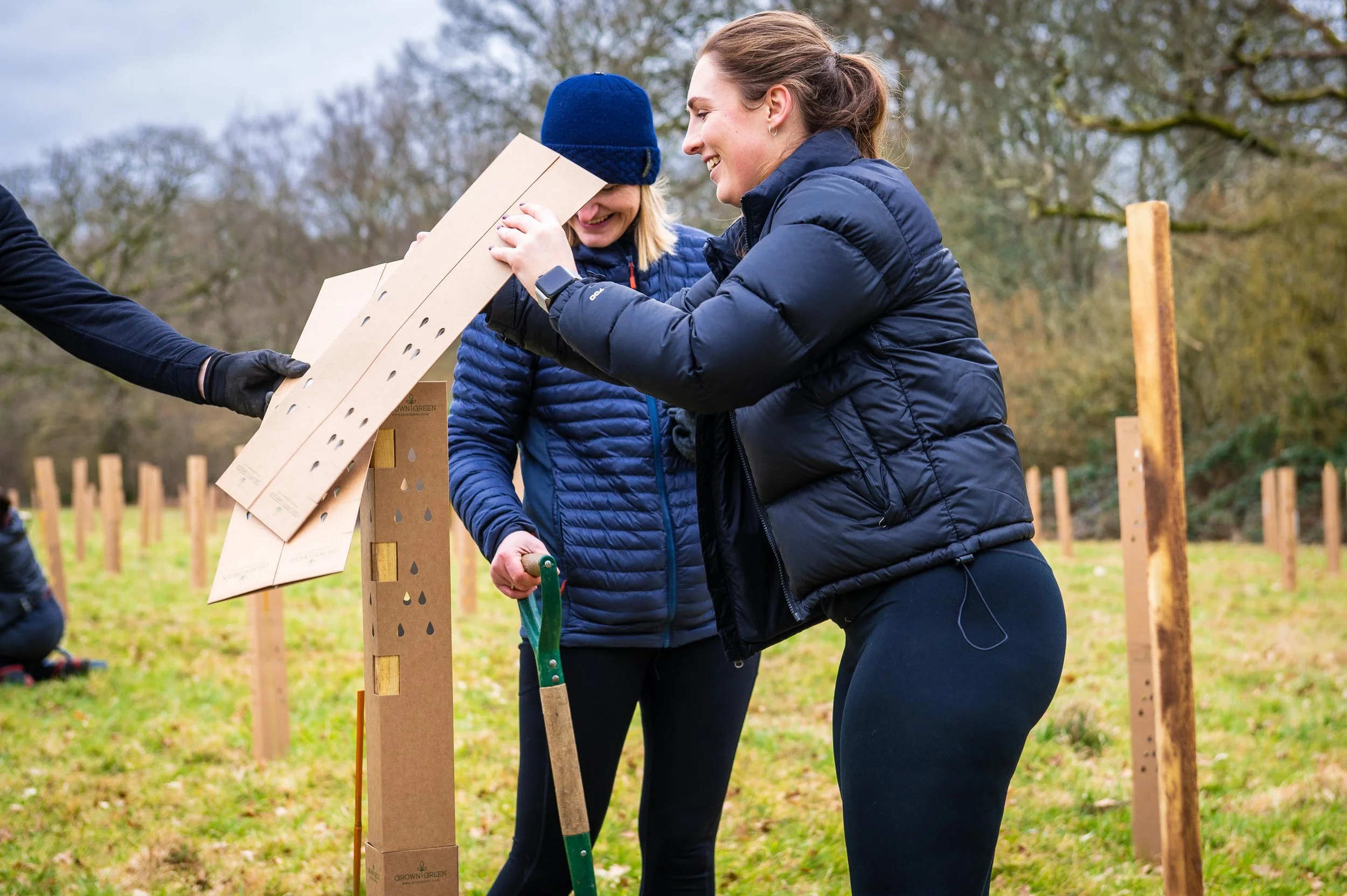
Unless it comes from recycled cardboard materials, surrounding trees with cardboard harvested from a tree sounds like a sadistic nightmare. It’d be like raising a cow in an abattoir. There is definitely a cruel irony. And that twist of fate—or window into the future—seems to be the case for some cardboard guard producers who do produce their tree guards from virgin paper products.
When Protect Earth tested cardboard tree guards, we found that within a short period, the deer had eaten through the guards to reach the saplings. What’s left of these guards also breaks down faster than required, leaving a young tree at the mercy of a curated nature where there’s an overabundance of deer, rabbits, and squirrels competing for food, and the tree has no natural defence or allies to protect it.
Corn starch tree guards
Corn starch-based tree guards offer an eco-friendly alternative for protecting young trees. The film, semi-opaque and off-white in colour, is certified biodegradable under industrial compost conditions, making it a sustainable choice for tree planting enthusiasts. These sleeves are typically installed using three bamboo canes and have a lifespan of 2 to 3 years, depending on environmental factors. They require no collection or recycling after use and won’t leave harmful microplastics in the soil or be ingested by wildlife.
These corn starch tree guards are a recent innovation in the market. While they are more expensive than traditional plastic guards, Protect Earth is eager to trial them in the upcoming planting season. The goal is to encourage the industry to adopt more environmentally friendly practices. If these tree guards are user-friendly and durable throughout the critical growth period for tree saplings, their popularity could increase, potentially lowering costs in the long run. This would achieve a perfect balance between sustainability and affordability.
Wool tree guards
Nexgen has been promising to introduce wool-based tree guards, and the wait has been filled with anticipation on Protect Earth’s part. Again, this plastic alternative guard will be more expensive than plastics, but material costs can’t be the only qualifying factor when considering guards.
NexGen shelters are manufactured from British wool. They break down naturally through a combination of biodegradable processes involving fungi, algae, mosses, and other soil organisms and environmental degradation from UV light, rain, ice, and wind. As they decompose, they enrich the soil and support the ecosystem without leaving behind hazardous materials. These shelters have passed rigorous industry-standard ecotoxicity tests and are pH-neutral, ensuring they do not disrupt the soil balance. They are guaranteed to last at least five years and do not require collection or recycling after use.
The ecological advantages of wool guards are significant and provide much-needed support to the British wool industry. The fluctuating demand for British wool often causes price instability, making life challenging for sheep farmers. Many have stopped viewing wool as a source of income and instead see it as a waste product they must dispose of. If the industry can pivot to these wool-based tree guards, hopefully, it’s an easier conversation to convince farmers to work together to create more natural habitats on their land! The tree-planting industry buys the wool from the farmers and returns a few months later to plant government-aided or NGO-aided projects (the trees and labour are essentially free for farmers). The farmer can claim further benefits by converting some of their farms to natural habitats, boosting biodiversity. And, of course, farmers’ yields increase with more robust biodiversity, and the farm running costs are reduced.
With all these benefits, you can see why Protect Earth is keen to try these technologies.
To sum up
As the journey through the various types of tree guards reveals, the selection and use of these protective measures are far from straightforward. While polypropylene plastic guards, such as those from Defenders and Tubex, offer reliable protection and cost-effectiveness, their environmental impact remains a significant concern. Though a step in the right direction, the recyclability of these guards does not fully mitigate the ecological footprint of plastic use.
On the other hand, alternative options like spiral tree guards, mesh guards, cardboard, corn starch, and wool guards present their unique blend of benefits and challenges. Spiral guards are easy to deploy and cost-effective but still contribute to plastic waste. Mesh guards, while durable and reusable, are costly and cumbersome. Cardboard and corn starch guards offer biodegradable solutions but struggle with durability and protection over extended periods. Wool guards, the latest innovation, promise a blend of biodegradability and support for local industries, but they, too, face hurdles in cost and widespread adoption.
Ultimately, deciding which tree guard to use involves balancing immediate practical needs with long-term environmental sustainability. Protect Earth’s efforts in trialling and testing these guards highlight the complexities involved in making the best choice for the saplings and the planet. As technology and materials evolve, the hope is that more effective and eco-friendly options will become available, paving the way for healthier forests and a more sustainable future.
Let’s see less plastic in the environment
If, like Protect Earth, you want to see less plastic being used to rehabilitate the UK and biodiversity, please donate to our “General Donations” pot. We can allocate donations towards testing more environmentally friendly options and moving towards more regular use of those that work, even if regular government grants don’t cover all the costs.