
Protecting River Roding from Japanese Knotweed

Every habitat in the UK is at risk of being destroyed by invasive species. Woodlands, wetlands, grasslands, lakes, ponds, rivers, everything you can imagine is having a rough time thanks to various imports from centuries past that have become uncontrollable, especially when left unchecked. One that many homeowners will be familiar with is Japanese Knotweed.
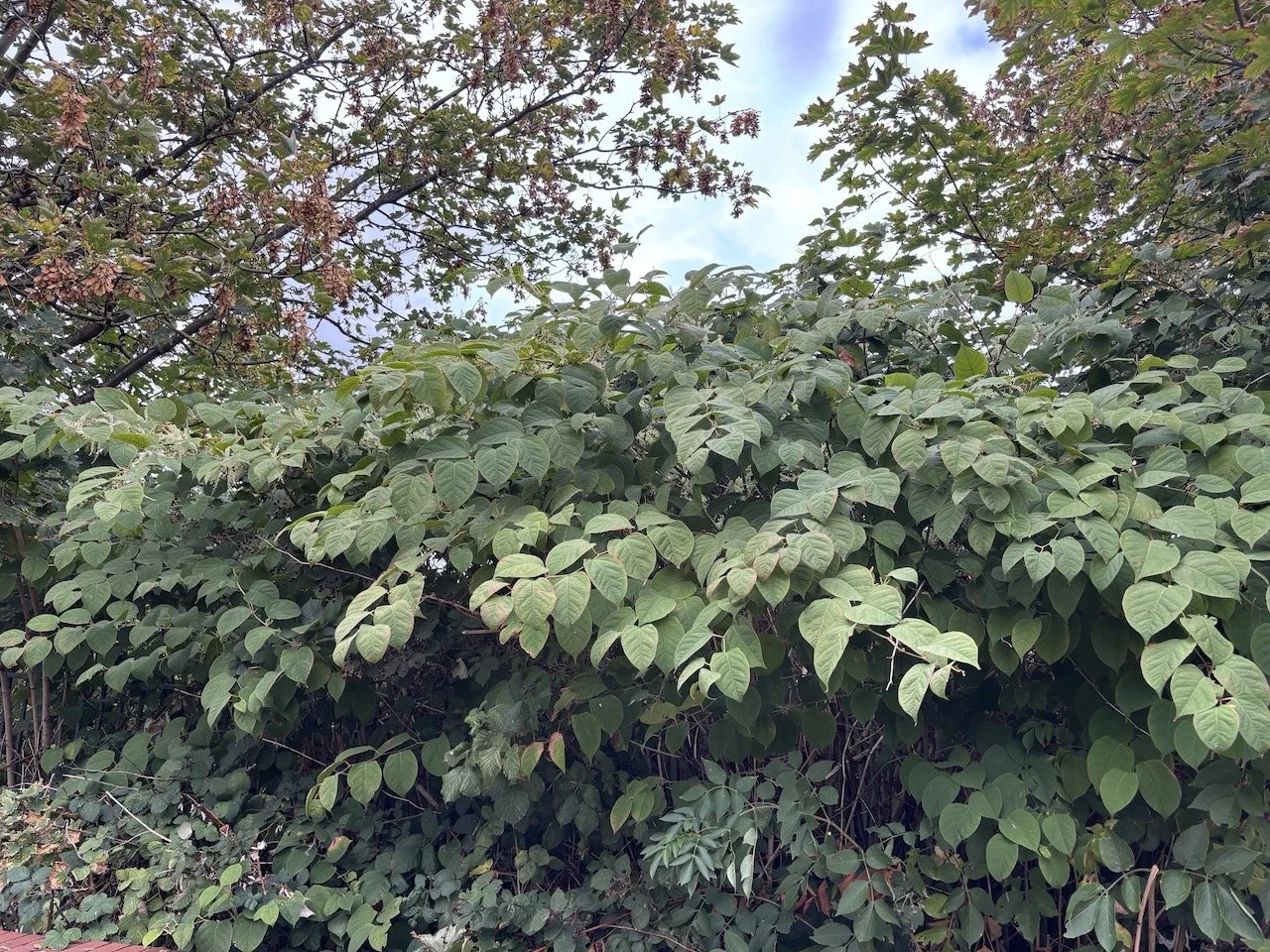
Japanese Knotweed is the one that specifically pops up on surveys when buying or selling a house, because the rhizomes (root structures) can push straight through foundations and come up through floors, causing subsidence and potentially destroying a building. Out in the wild it’s just as problematic, creating huge dense clusters that shade out every other single species decimating biodiversity! The only plant I’ve ever seen successfully growing through Japanese Knotweed is Himalayan Balsam, another invasive species…
These species both easily proliferate through river systems and then outwardly into nature and peoples gardens. Some say even a few centimetres of Knotweed breaking off can regrow, which is why there are such stringent rules and regulations about its management, as well as massive penalties and fines and even court proceedings for just ripping it out. Especially if you take it to your local recycling centre or put it in your green waste bin!
River Roding Trust
Paul Powlesland from the River Roding Trust got in touch with a problem.
The River Roding is a tidal marsh, which is a particularly rare habitat nationwide, but especially in London. The river and its banks of reedbeds are already in a poor condition. There is all sorts of pollution, illegal sewage overflow, and mind boggling levels of litter. All of this is being dealt with by the River Roding Trust through a combination of direct action, community science, and hassling the council. The marsh is doing what it can, with its reeds helping filter the water as much as it can, but that’s where the Japanese knotweed comes in.
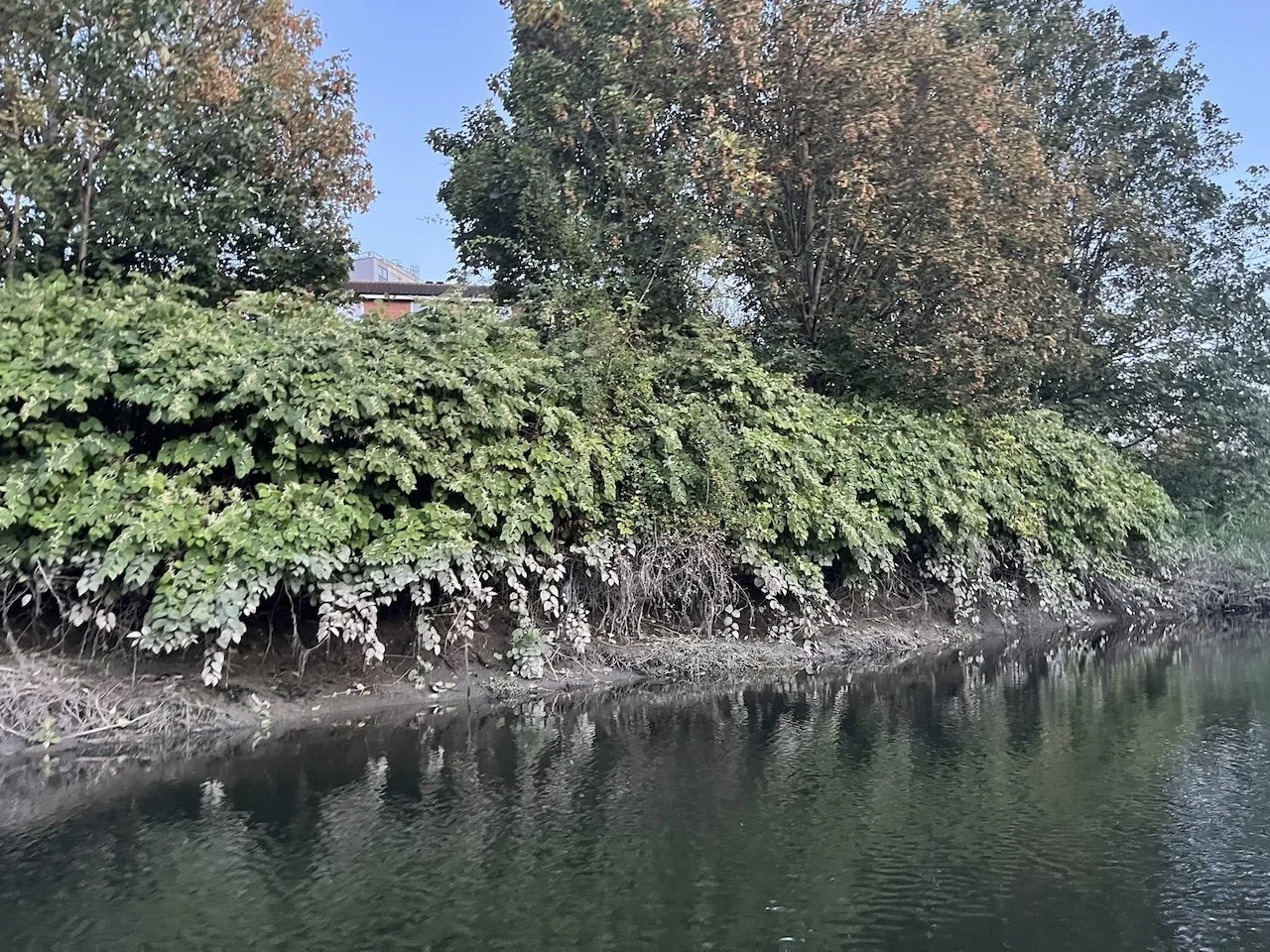
Japanese Knotweed is taking over the reedbeds, shading out the native reed species, and hampering the rivers ability to remediate the pollution and sewage in the river. We need to be bolstering and expanding the reedbeds, improving the natural water filtration of the river, because losing any space to this invasive species is heading in the wrong direction with a species known for exponential spread and growth. If the knotweed isn’t taken care of rapidly, it could be too late.
Paul posted this photo of the ridiculous growth of Japanese Knotweed on the River Roding after struggling to get the council to do anything about it.
The River Roding team were applying for various river restoration grants, but as always seems to be the case, the grants do not come close to the real world cost of hiring experts to do this sort of work. Paul’s search for help brought him to Protect Earth, after seeing how much I love removing invasive species to fix habitats all over the UK. We put our heads together, got Steve the Ecologist to write up a plan, and got everything in motion.
Map the Problem
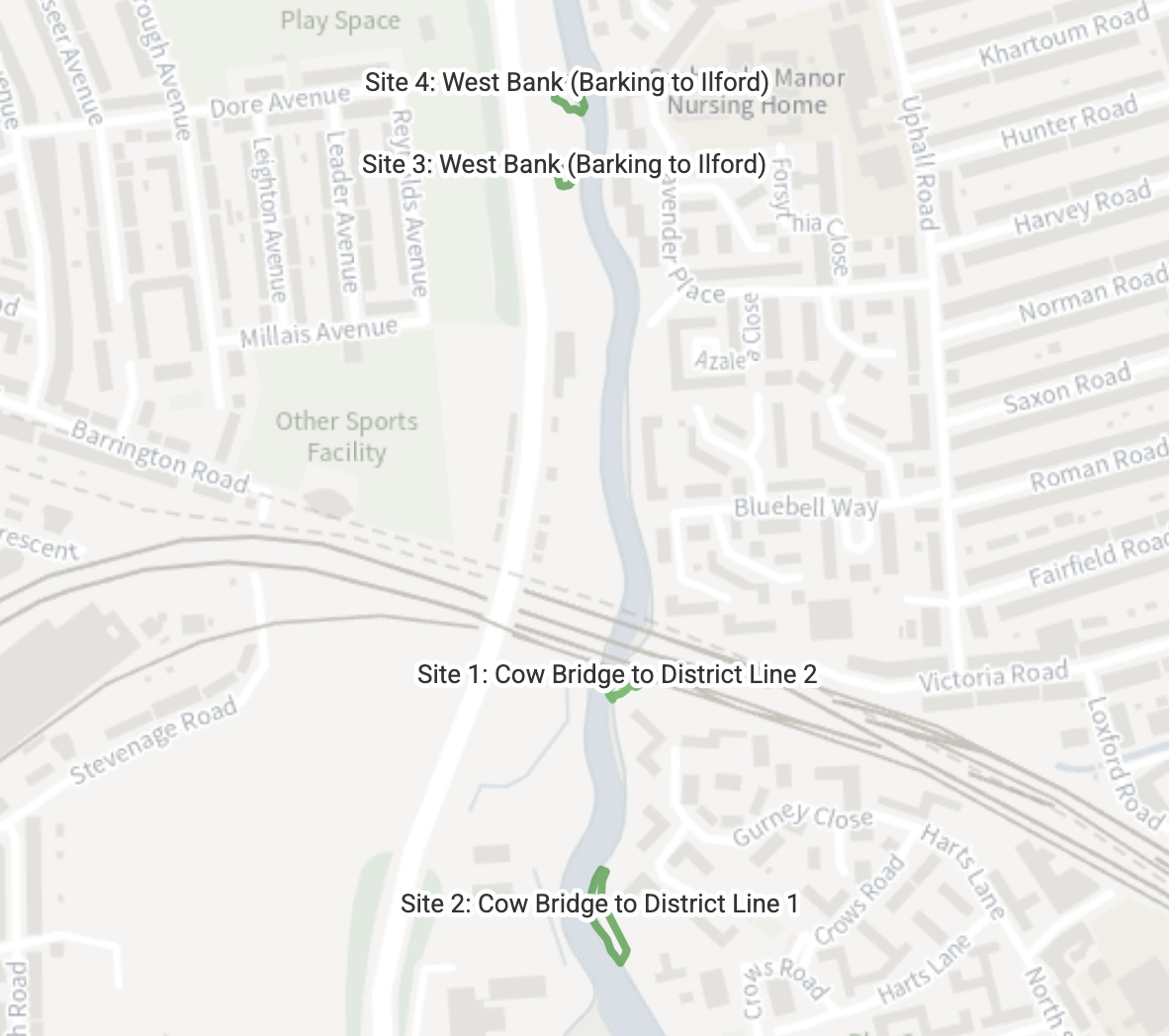
The first step to anything is finding out exactly how much of a problem you have. Paul and the team had done an amazing job of finding and mapping most of it, with a combination of ground truthing and satellite imagery.
At first this was popped onto a Google Maps list, and we quickly moved it over to The Land App to get a much more accurate calculation of the extent of the task & a bit more control over things.
Get Environment Agency Approval
Pretty much anything done near any river needs approval from the Environment Agency, especially when it comes to Japanese Knotweed.
We discussed the approach, and with it being directly on the river banks the mechanical approach of digging 10 meters down to remove it was completely out of the question for countless reasons. The approach chosen was chemical control, using the industry standard option for this sort of work: glyphosate.
This is a controversial topic, and many councils are starting to ban the use of this stuff because of concerns about health & environmental impacts. I am overjoyed that councils are moving away from spraying down bus stops, play areas, benches, and every sidewalk regardless of if there’s a single blade of grass out of place or not, that was always silly and it should absolutely be banned. Garden centers should not be selling this stuff to anyone who fancies doing whatever they want with it either.
None of us at Protect Earth take using glyphosate lightly. With careful usage of herbicides, we can effectively remove invasive species that would otherwise cause far more damage to the environment left unchecked. For best results we focus on cautious methodology like injection, and targeted spraying, following every best practice in the book, and stick to chemical free options for any species we can, like Himilayan Balsam.
Ground Preparation
The most important thing to do is to prepare all the ground before you go. Carefully cutting access paths in spring, so that when you come back in late summer / early autumn it’s not a nightmare to get in there. Then you can bag up the cut pieces, stick them in heavy duty bin bags, and let it all “cook” in the sun.
With this being a tidal marsh, those bags would have been picked up, dragged up and down river, torn to pieces, and the plastic and knotweed both spread all over the area.
One key thing to know about Japanese Knotweed is that it can regrow from a piece as small as the nail on your little finger. The goal was to not cut a single piece. Don’t rip any out, or snap anything either.
Getting Stuck In
If all of that was different and we had infinite time and infinite money we could have done something about improving access, but life isn’t like that. We settled for getting creative, and it actually worked out brilliantly. New team member Michael Cunningham and I had a boat, a long handled rake, extra-long spray booms, all powered by enthusiasm and a grudge.
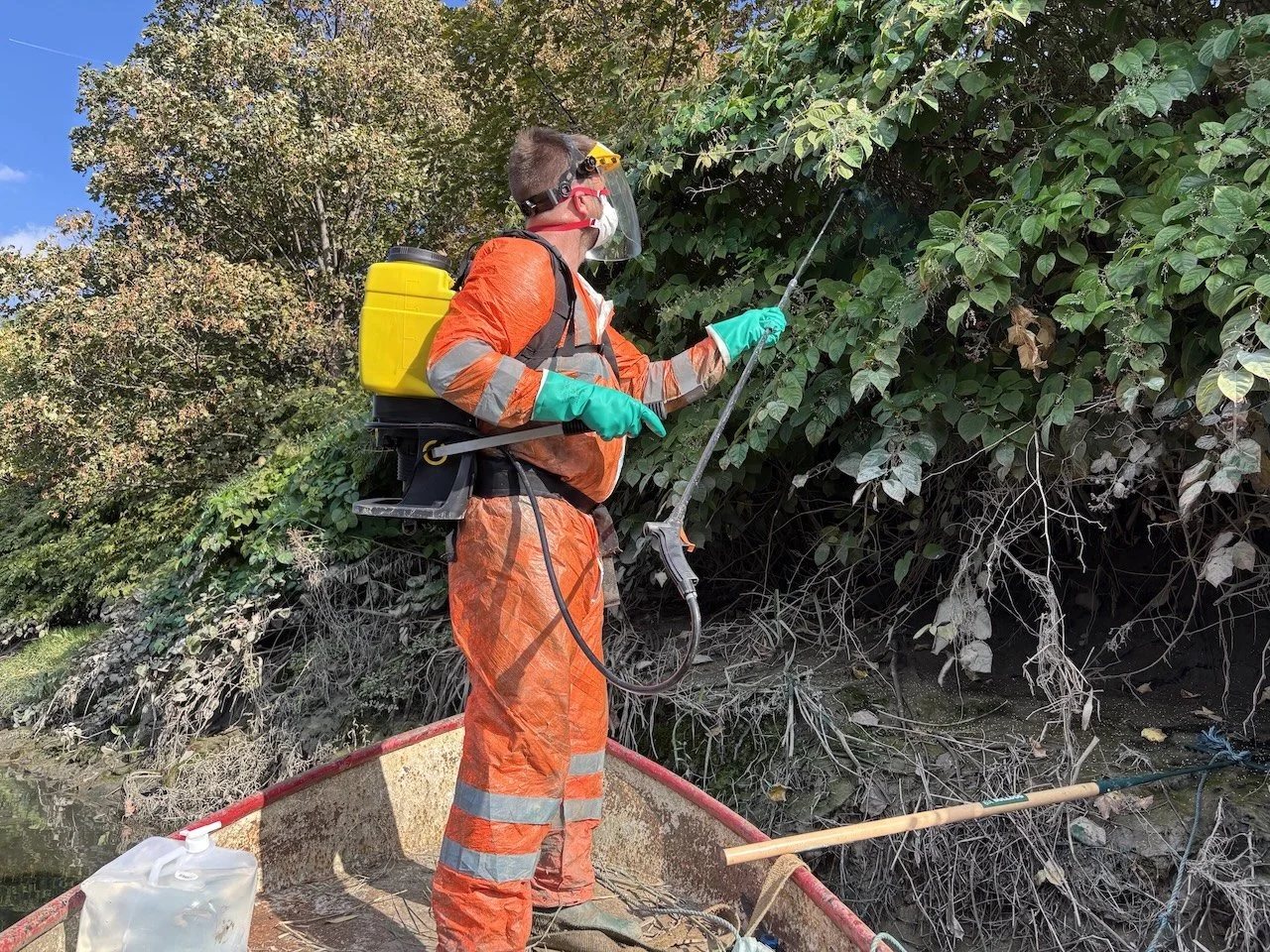
We scheduled two weeks to handle the mapped areas, with the expectation being four days in the field with four more days in case of adverse weather. Good thing we did, as this job needed all eight days thanks to us discovering more stands of knotweed than was known about previously. One hectare, or two and a half acres. Eeep!
The work took us all over Ilford and Barking, from Aldersbrook to Cuckolds Haven, we covered 15 different areas completely covered in knotweed. Huge patches, with stumps so old they looked like ancient hazel stools.
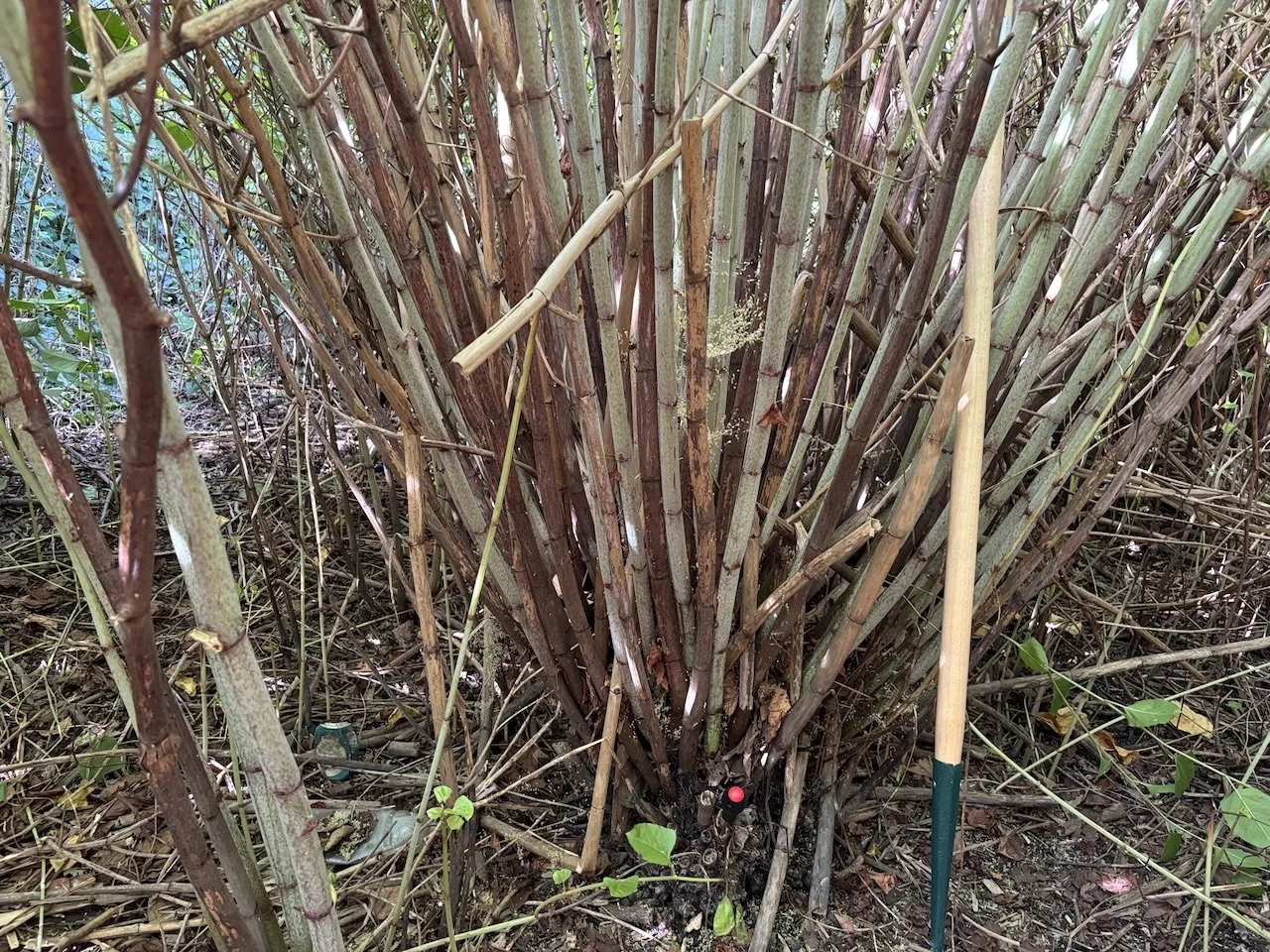
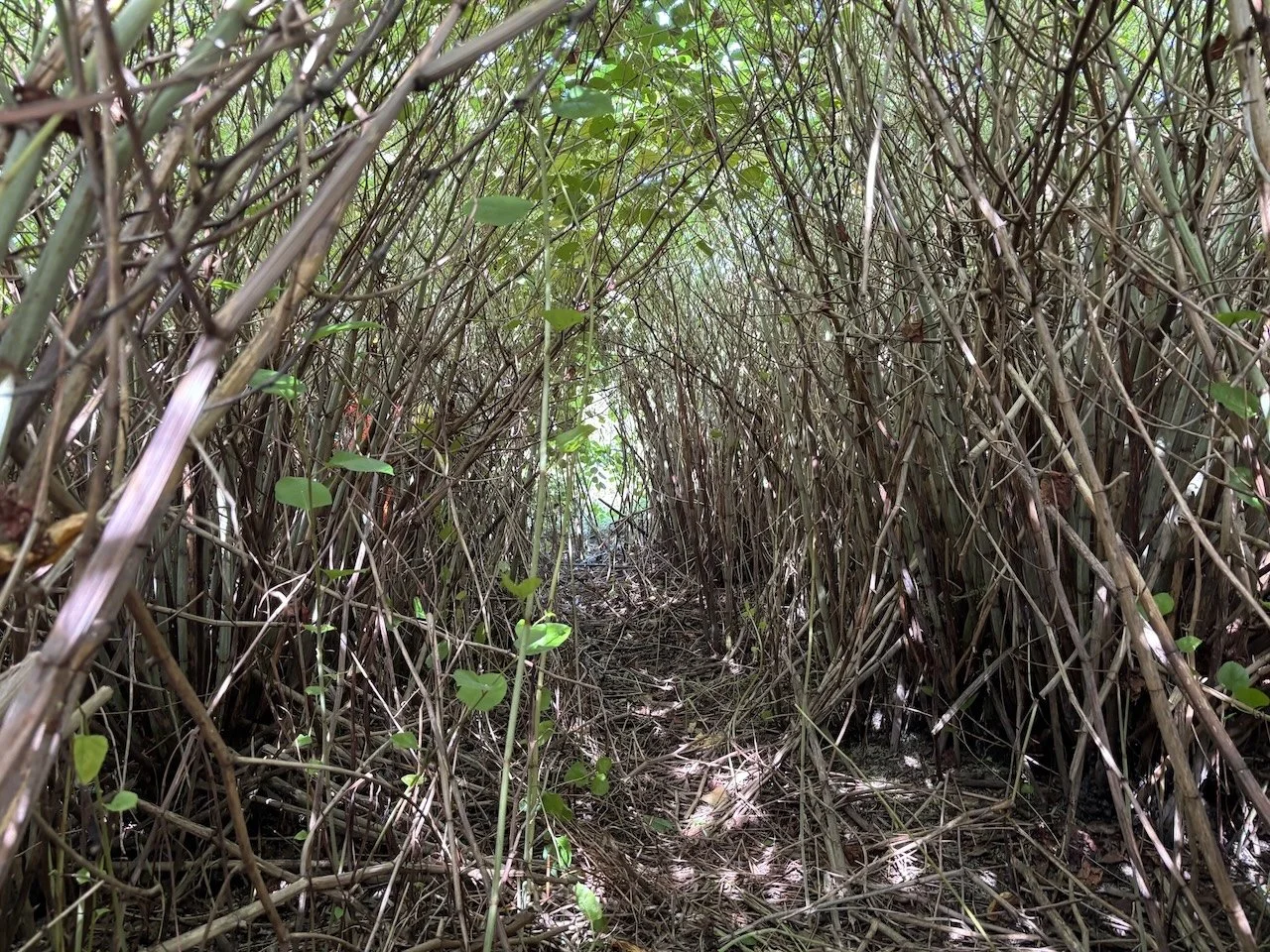
There was no chance for injection to get anywhere, most of this was hard as wood. We had to get into the leaves, and that meant a big long boom on our knapsacks. Two meters was enough to get onto the leaves. We’d treat smaller patches from the outside, but the larger patches needed access paths, and without cutting the best I could think of was bending. The long handle rake came in super handy here. We could push our way through smaller growth between the mega stools, creating these corridors that were easily navigable.
Some of the areas were less forgiving. Getting permission from the Nissan dealership to rock climb down a dodgy wall to then end up stuck in silt, now shin deep, now knee deep, now waist deep… calling for my teammate to pull me out before I was face deep. You might have grown up and thought quicksand wasn’t the major threat that movies made us believe when we were young. But then you go and get in the Aldersbrook with a heavy knapsack and relive the scene from Indiana Jones: Temple of Doom.
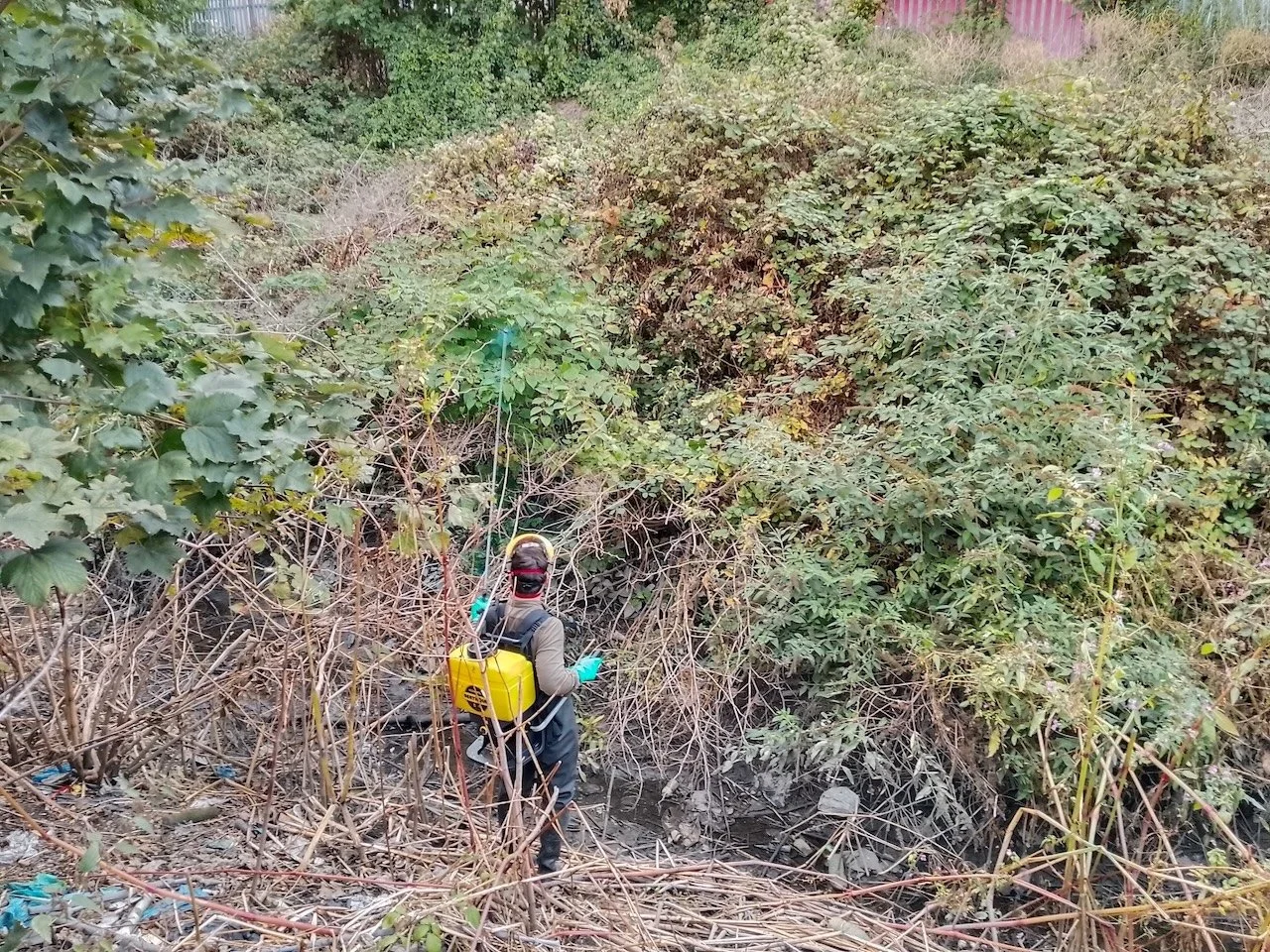
It was a wild, wet, and smelly, time, but evry patch we could get to we covered the up to 80% of the foliage, which we are extremely happy about due to difficult access for most of these areas.
How’s it going?
To save us a trip to London just to see how its coming along, Paul sent us some photos one month after treatment. In this photo for example, you can see the line where our booms could reach, The sprayed stuff is yellow, the leaves we could not reach are still showing as green. The yellow shows that the herbicide has done its job, blocking up the sap passageways as it moves through on its way to the roots.
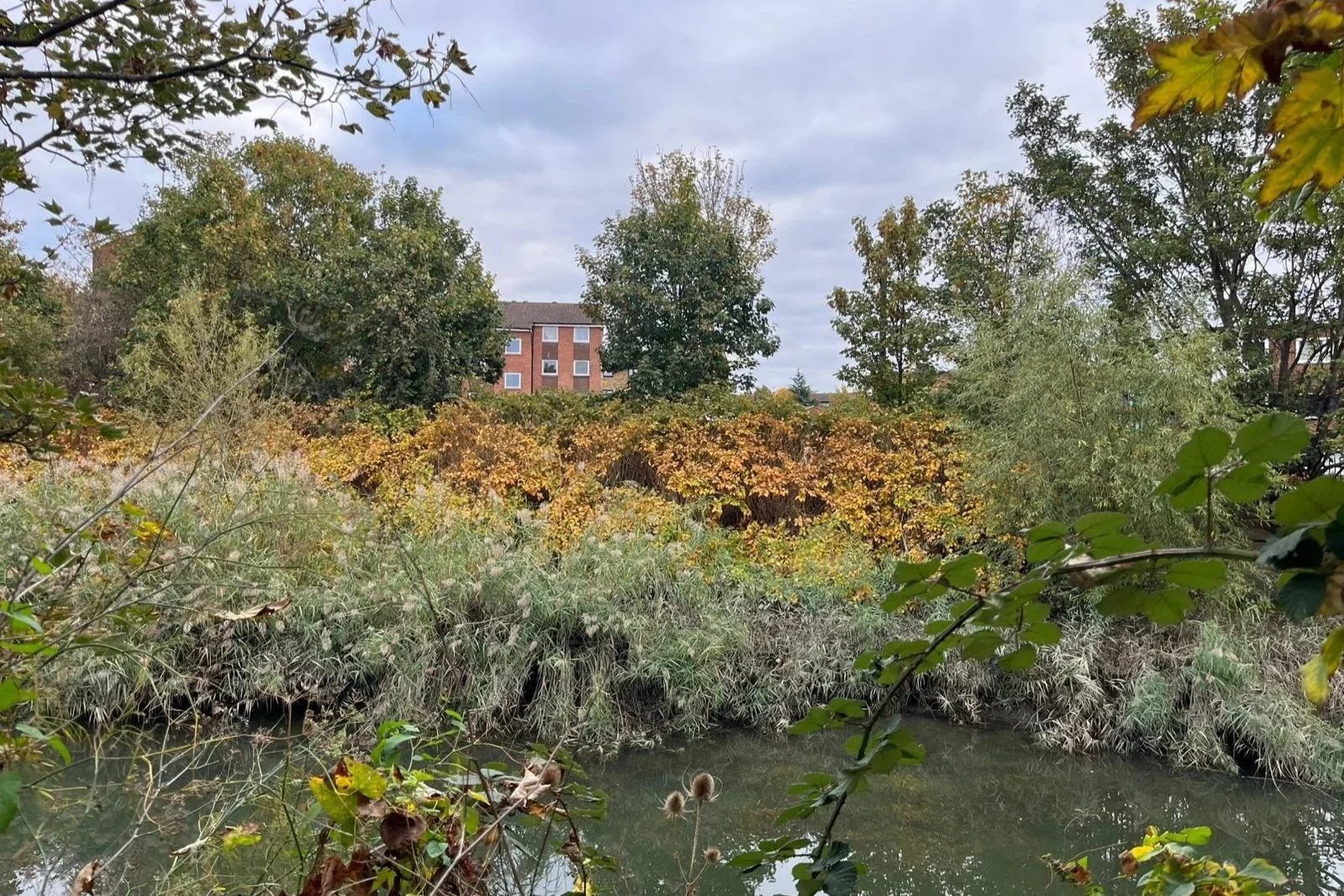
This photo not only shows the knotweed is dying, but I think more importantly it shows that the surrounding growth is still doing just fine. Targeted spraying is not easy, but keeping an eye on wind speed, good boom control, and a huge amount of care and attention for the surrounding ecosystem gets you a good lot of the way there.
Next steps
The River Roding team however will be on the case. Revisiting all 15 spots, keeping an eye on things, removing rubbish to help make access safer, and we’ll be trying to cut and safely remove as much as we can where we can so it’s easier to spray next September.
The goal is to kill as much as we can reach each year, and based on this year’s work that was well over 80%. If we keep doing that, it’ll be gone entirely in no time, and each year the reeds will recolonise their old turf until they are thriving undisrupted, working full time to improve water quality even if the water companies don’t bother.
Our Impact Store recently added Ancient Woodland Restoration sponosorship, and soon we’ll be adding Wetland Restoration sponsorship soon so we can get this work done when no grants exists, but until then chuck us a general donation and comment “do something wetland related” in the donation message.