Ancient woodlands are living time capsules. Formed over centuries, their value runs deeper than their canopy—it’s in the soil, fungi, veteran trees, and the species that evolved to call them home.
Sadly, many of the UK’s ancient woodlands were cleared and replanted with conifers, fueling the timber industry. These woodlands are now referred to as PAWS—Plantations on Ancient Woodland Sites. They may look like your average pine stand, but under all that uniformity lies an irreplaceable ecological archive just waiting to be brought back to life.
Ancient woodland restoration isn’t a free-for-all. It works best when rooted in a solid plan, and there is a well-regarded framework that goes something like this: assess, plan, structure, species, restock, open spaces, manage pests, and protect what’s rare. It’s a practical checklist that we’ve incorporated into our activities at High Wood in Cornwall.
1. Assessment
Restoration begins with taking a long, honest look at what’s there. That means mapping soil types, tree species, age structure, any ancient woodland indicators, and even whether it has a good footpath network or deer are nipping new shoots.
High Wood Reality Check:
We inherited a 25.59-hectare PAWS site where half the woodland is a 1960s conifer plantation, and a block of 1920s Douglas Fir still stands tall. Just over 10% of High Wood is comprised of native broadleaf species (mostly English Oak), and the soil is free-draining, slightly acidic, and not overly fertile.
2. Planning
All good things start with a plan, and a restoration plan is how you balance ambition with logistics and biodiversity goals with budget.
Our Plan in Practice:
In 2022, we mapped our first 5-year plan for High Wood, having only taken over the woodland. Ultimately, the goal is to revive High Wood as a biodiverse Celtic rainforest. To achieve this, the first five years involve thinning and gradually removing conifers, leaving the best Douglas Firs as a heritage feature and encouraging natural regeneration with species such as Oak, Rowan, and Wild Cherry. We’re also holding off on planting in the short term to keep access open for machinery and to let nature do what it does best.
[caption id="" align="alignnone" width="991"]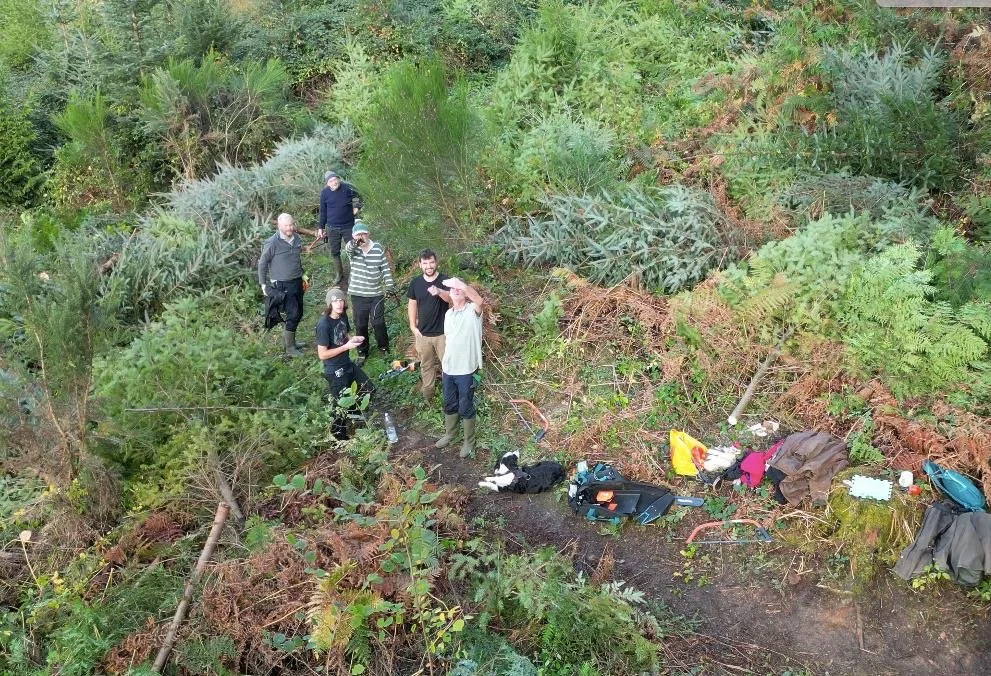 Professionals and volunteers together have removed over 900 tonnes of conifer from High Wood since we’ve taken over management [/caption]
3. Woodland Structure: Layers Matter
A healthy wood isn’t just tall trees—it’s a mix of ages, gaps, thickets, and glades. This diversity supports everything from insects to owls and makes the whole woodland more resilient.
Structure at High Wood:
We’ve got a way to go. The conifers dominate, but those old oaks and the few remaining broadleaf patches are our anchor points. We have halo-thinned around the old-growth natives to let in the light and free up the understory. Slowly, that chaotic patchwork of age and structure will return across High Wood, balancing new and old, light and shade.
4. Tree Species: Right Trees, Right Place
Native species are the best bet—they have evolved in tandem with the land and support a greater diversity of wildlife that has also developed in lockstep. But it’s not just about what’s planted; it’s also what is left, what self-seeds, and how nature is left to lead.
Species at High Wood:
When we start planting, we’ll plant the following: Oak, Rowan, Silver Birch, Wild Service Tree, and even Cornish Elm. No Ash (thanks to dieback) and no Sycamore. Slowly but surely, we’re removing conifers, making more room for natural regeneration and tree-planting activities where they’re truly needed.
5. Restocking Or Natural Regeneration
The debate between human-led planting and nature-driven natural regeneration is a frequently discussed topic. Doesn’t need to be as they are different tools in the same belt and can be used to good effect when called for.
[caption id="" align="alignnone" width="4032"]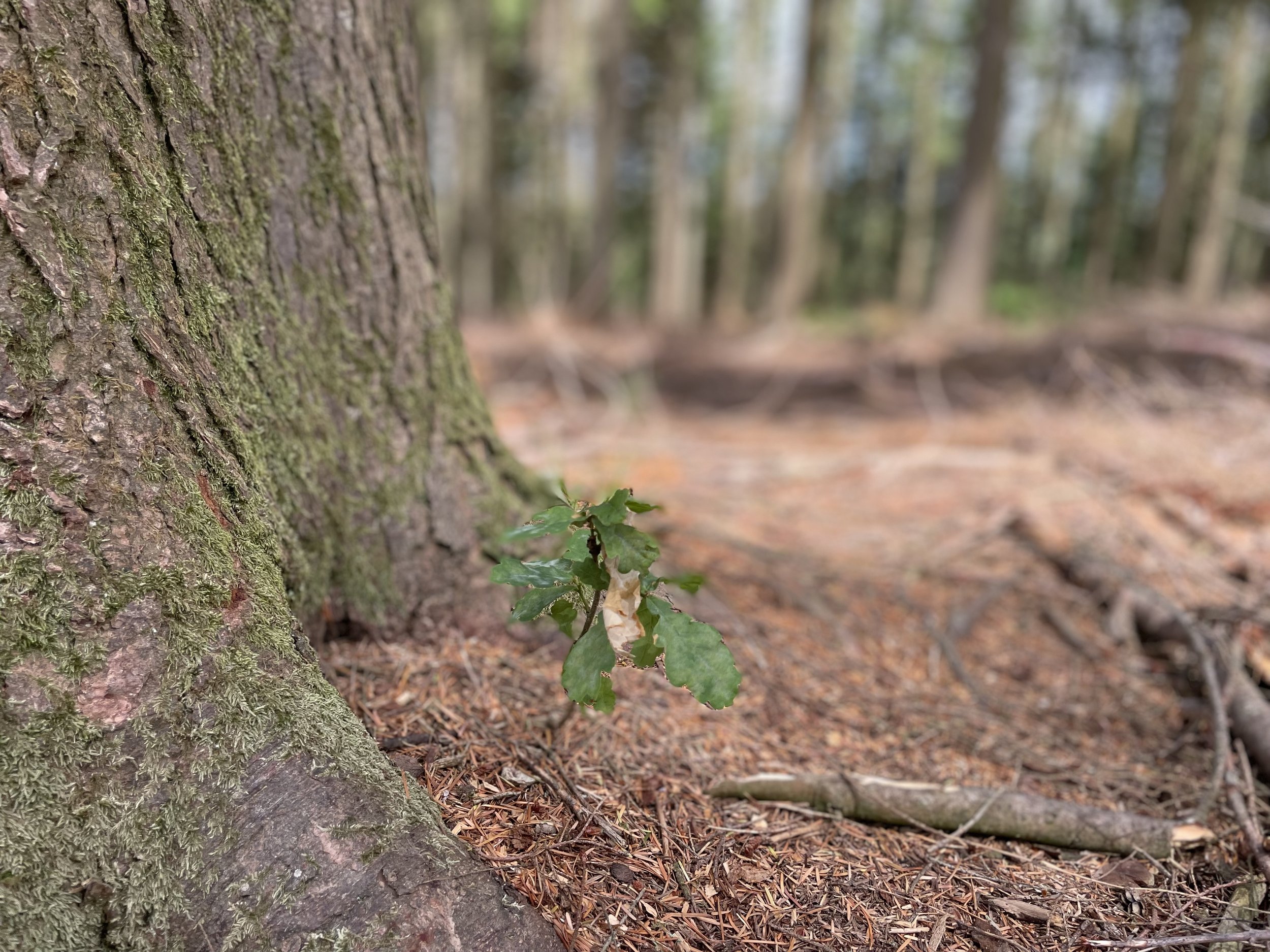 Nature finds a way. Signs of regeneration in High Wood [/caption]
Our Approach:
We’re letting nature take the lead. No planting will occur in the first five years, but when we do, it’ll be with species already found locally. And we’re not rushing to remove all the conifers at once—this would send the woodland into shock, which would be devastating to the space. Also, recreational woodland users want to go to the woods to see the woods, not the ugly scars of clear-cut trees.
6. Open Areas: Let the Light In
Glades, rides, and clearings are magnets for biodiversity. They create microhabitats and support pollinators.
Open Spaces at High Wood:
We’re clearing glades in the densest areas among the conifers, widening rides, and maintaining historic openings. Around 20% of any newly opened area will remain open. Sunlight, after all, is the best disinfectant for a conifer monoculture. Wildflowers can spring forth, encouraging pollinators to dine.
7. Species Management: Not All Plants Are Welcome
Restoring ancient woodland means being selective, identifying species that are not benefiting the space and removing them permanently. Invasive species, such as Rhododendron, Cherry Laurel, and Himalayan Balsam, for instance, need to be managed (otherwise known as destroyed) if native species are to thrive.
Our Hands-On Battle:
We’ve isolated pockets of Rhododendron that are receiving the glyphosate treatment, and we’re working with neighbours to keep garden escapees like Bamboo at bay.
We’re installing bird, bat, and dormouse boxes, encouraging these species to take up residence in High Wood.
8. Species Conservation: Spotlight on the Rare
Some species need more than good habitat—they need a helping hand.
High Wood Highlights:
Our stars are the semi-mature Oaks. We’re halo-thinning to release them from the conifer stranglehold. It’s a delicate process—too fast, and the change in light and wind can do more harm than good. Slow and steady wins this ecological race.
To Sum Up
Restoring an ancient woodland isn’t about going back in time. It’s about giving nature the tools, time, and space to write its next chapter. At Protect Earth, we’re doing that one tree, one thinned conifer, one halo-thinned Oak at a time. High Wood might not look ancient—yet—but dig a little deeper, and the roots of the past are still very much alive.