
The Hidden Cost of AI: Energy, Emissions, and Climate Impact

Artificial Intelligence has been everywhere since ChatGPT first dropped in late 2022. Want an imaginative image? Want a technical drawing to show your architect how you want a kitchen refurbished or a new conservatory to look? Want to write a bedtime story based on your child’s day? AI will do it all without breaking a sweat. Or, so we thought. We input a command into the field, and the interface whistles, whirrs, and pops, and then we get something close or far from what we had in mind, depending on the strength of the prompt. Behind all that whirring and chugging is some high energy consumption.
Trillions of dollars are projected to be invested in AI and it’s worth understanding the complete picture of how AI stands to impact people.
This thought piece examines the less talked about side of artificial intelligence, its energy consumption, and its potential impact on climate.
What is AI and how it works
Artificial Intelligence is when machines access data and information, linking information or a string of data points together for an intelligible output.
To arrive at a useful and intelligible output, AI models are trained on loads and loads of data about all sorts of topics. AIs can also turn around non-creative and creative outputs.
An example of a non-creative output is if I were to ask someone how to go to the corner shop from where I live, they would tell me, “Turn left out of the front door. Walk to the end of the road. Turn right. Walk straight and take the third right. Walk about 50 metres, and the shop is on the right.” To issue those instructions and for them to be interpreted correctly, humans need to know what walking means, the directions left, right, and straight, what a road is, what metres are, what 50 represents, and what a shop is. And, we need to share a language so messages can be shared from one to another. Mode of movement, directions, surfaces, and distances could all be considered data points. And AI models, like people, will be trained on all data points to correctly understand a query, access relevant information to that query, and turn around an output that meets expectations, like when someone might ask you how to get to the closest corner shop. AI tools are also taught about language so the answer they turn around is coherent and understandable.
When asking an AI to create an image of a forested landscape in the style of J. M. W. Turner, the model needs to know all these variables to turn the query around to expectation. For instance, the model would need to know what a forested landscape is - including colours and textures - who J.M.W. Turner was and the characteristics of his painting style. It won’t reproduce any of Turner’s pieces. Instead, the model will identify Turner’s characteristics and mimic those to create something new based on its interpretation of the prompt and J.M.W. Turner.
While this only scratches the surface of AI’s capabilities, it highlights the fundamental way these systems are trained and function.
AI’s Accessibility
Since ChatGPT’s launch, AI tools have become accessible to anyone online, sparking innovation across industries. Established platforms and new companies have integrated AI into their products, bringing advanced capabilities into everyday tools on computers, tablets, and phones. These developments aim to simplify our workflows, enhance productivity, and enable us to achieve more and faster.
How AI Contributes to Carbon emissions
Now, we are getting to the meat of this piece. AI has received a lot of attention for everything it can do. Despite all the attention garnered by this innovative technology, a few areas are still quite murky, with creators wanting things to stay just as they are, which is unclear. The significant areas are what information these models are trained on, how they work towards eliminating bias, and the environmental impact of using these tools - we are concerned with AI’s impact on the environment.
Artificial intelligence models use servers in data centres. Processing and storing data requires large amounts of energy and water for cooling. Every time artificial intelligence creates an image writes a text message or responds to something as a chatbot, it consumes energy. How much energy? We don’t know exactly. All we can do is guess.
The Numbers Behind AI’s Energy Demand
The environmental cost of AI is significant and increasingly urgent to understand. Each search we perform on a platform like Google uses about 0.0003 kWh—equivalent to 0.2g of carbon dioxide emissions, or enough energy to light a 60-watt bulb for 17 seconds. With 8.5 billion searches daily and 2 trillion annually, this adds up to 1.7 million kg of CO2 per day and an eye-opening 400 million kg per year.
AI, however, is even more energy-intensive. Depending on the complexity of a query—whether it’s text, an image, or a video—it can consume 5 to 10 times more energy than a standard search. The annual CO2 output could range from 2,000 to 4,000 billion kg.
There are those who are doing their best to piece together information to calculate AI’s environmental impact. The most cited is Alex de Vries, a PhD candidate at Vrije Universiteit Amsterdam with the Institute for Environmental Studies. Alex de Vries published his analysis in Digiconomist Joule. He has calculated that AI’s current energy demand is similar to that needed to mine cryptocurrencies. You may remember a big argument against this technology because of its intense energy demand. He has further speculated that the annual demand for electricity by artificial intelligence worldwide could increase from 85.4 to 134 terawatt hours by 2027.
The International Energy Agency echoes these concerns, projecting that energy use in data centres—driven by AI and cryptocurrency—could rise from 460 terawatt-hours in 2022 to between 620 and 1,050 terawatt-hours by 2026. To put this in perspective, such consumption could meet Germany’s energy needs for an entire year.
AI vs. Other Industries: A Carbon Emissions Comparison
The nascent AI industry’s carbon footprint is still shrouded in mystery despite the big tech companies releasing environmental impact reports annually.
This section will help you understand the above estimates by comparing data centre emissions with other industries and the carbon footprint they create.
For context, every activity people undertake creates around 40.9 billion metric tons of carbon dioxide annually.
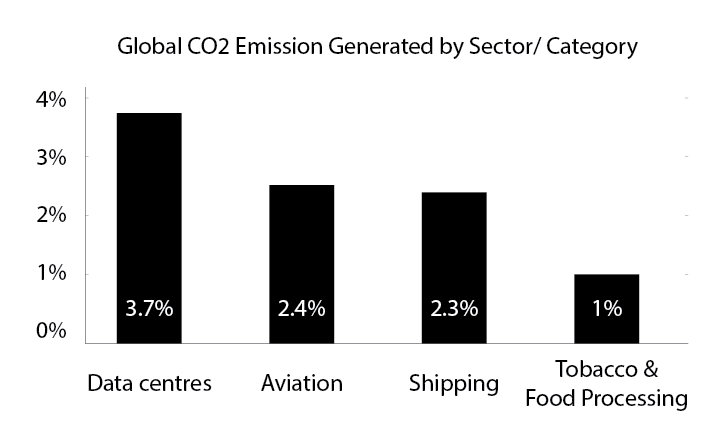
Above, we can see the neighbourhood in which data centres are located. The airline industry has long been criticised for its carbon footprint. Yet, it’s smaller than data centres. And, if you’re watching a documentary on YouTube or Netflix about the aviation industry’s contribution to climate change, know that that documentary will probably be housed in a data centre (a bigger carbon source than the aviation industry).
And, just to see the other side, the average household in the EU emits around 10 tons of carbon dioxide per year.
Will AI Technology Become More Sustainable?
As technology advances, it becomes more efficient and energy-efficient. Yet, the growing demands on AI and the data centres driving it tell a different story.
With increased implementation and more complex uses, AI’s environmental impact remains a challenge. A research group estimates that by 2028, computing performance will improve fourfold, but processing workloads could surge 50 times, driven by more intensive queries and sophisticated models with countless parameters. By 2030, energy consumption in European data centres is expected to rise by 28%, highlighting the urgent need for sustainable solutions in tech infrastructure.
To sum up
AI has made its stage debut in a grand fashion. And it’s not leaving. Arguably, companies are betting a lot on this technology - so much that they’re trying to sweep aside various concerns (including environmental impact). As easy as AI makes life for understanding the world around us, it also has tremendous capabilities for making the world more difficult to navigate through its contribution to climate change. We should also consider strategies for mitigating the projected increases in greenhouse gas emissions and the consequent climate effects.
In the face of this significant, impactful change, we need to be acting now to mitigate the changes that may occur due to this technology. Protect Earth’s mission is to restore natural spaces to help prevent flooding, hotter summers, increased rains all of which brings more volatility and increased cost to the UK.
Help us help you and donate to our Land Fund so we can buy land to restore it naturally.
Sources
-
https://www.theverge.com/24066646/ai-electricity-energy-watts-generative-consumption
-
https://news.climate.columbia.edu/2023/06/09/ais-growing-carbon-footprint/
-
https://climatetrade.com/the-worlds-most-polluting-industries/
-
https://www.statista.com/statistics/1305696/apparel-industry-co2e-emissions/
-
https://www.statista.com/statistics/1285502/annual-global-greenhouse-gas-emissions